Children

Telling Bible stories to young children

Once again my wife reflects upon one of our passions – how to present gospel stories to children.


The story of Jesus washing His disciples’ feet. (John 13:1-17)


Traditionally, we concentrate on Jesus, the teacher, humbling himself to wash the feet of his disciples. However, to a young child, this would not seem unusual at all. Their experience is normally one of adults caring for them; teachers and childcare providers, parents, and grandparents. It would be strange to them if the disciples had washed Jesus’ feet!


So how could we tell this story?


Often Bible storytellers try to interpret the stories. We want to be sure the child understands the meaning and the lesson. In short, we tell the child what they should think.

I’m wary of this approach.

I believe that when we impart God’s Word to young people the Holy Spirit is present and active in their hearts and their heads.children 1

We need to trust that He will guide them as they hear our stories.

Our aim should be to facilitate worship in children.


The lives of children are full of friends, family gatherings, travelling, food, and identity. This story has it all. Jesus plans a meal together with his friends. They all travel to an upstairs room in a house. They probably walked along dusty roads to get there. When they arrived there were probably hugs and kisses all around. The table had an array of food and drink, lovingly prepared by others in their circle of friends.

Most importantly, Jesus was with his friends: they identified themselves (and the community recognised them) as His followers.


So, as you tell this wonderful story, touch on these points of contact.


Children will also visualise the story as you tell it. They will “see” it using their own experiences. Therefore a table full of food will be their family’s dining table.

Enrich the story for them by telling them the colours, the smells, the icky ness of the dirty feet, the warmth of the water in the basin, the gentleness of Jesus hands, and the softness of the towel.


When we tell stories in this fashion we help a child take it into their heart. The story will resonate with them.


And finally, give the child a way to respond to what they have heard. Wonder with them, sit quietly and ponder, provide art materials, sing. Follow their lead as they follow the Holy Spirit.

 

Categories: Child Theology, Children, christian, Faith, Family, Hetty's Devotions | Tags: , , , , | 1 Comment

Jesus Unicorn

Today my wife, Hetty, is presenting a guest blog on the topic of children and worship.

Jesus Unicorn

Courtesy Google  images

Courtesy Google images

A young girl was given a notebook and some colouring pencils and pens while she sat in the pew with her family.  After a few weeks, her parents suggested that she listen to the sermon while she drew. By the end of the sermon she had drawn some pictures of a unicorn with the words ‘Jesus Unicorn’ above them.  Her parents were amused.
 
Some questions:
 
  • What did her parents believe children should be doing in a worship service?
  • Did they give her any guidance about what she could do with the writing and drawing materials?
  • What was the underlying message the child got concerning how she should behave in the worship service and from her parents’ subsequent suggestion?
 
Some ideas:
 
If you were her parents, how might you encourage her to participate in the worship service?
How would you begin a discussion with this child about ‘Jesus Unicorn’ which could lead her to a fuller experience of worship?
 
Paper and pencils are fine to keep a child’s hands busy, to keep a child quiet, and even as a stepping stone to taking notes of the sermon but it should never stop there.
Children can draw the stories they hear (and they should be hearing God’s stories, not just theological concepts) or their feelings. There should be a clear understanding of when they can draw/write and when they should be participating in the singing, praying, etc.  Parents should follow up with the child later. It may help if the parents also occasionally used paper and pencils during the sermon, and the family shared their pictures afterwards.
 
A warning:
 
Be careful not to let this become another kind of ‘school’ activity.
Help the child to use the writing and drawing, as well as the words they’re hearing and the images they’re seeing, as a way to explore their understanding of God, and the worship of Him.
 
 
Hetty Stok
Categories: Child Theology, Children, christian, christian education, Christianity, Church, Uncategorized | Tags: , , , | 8 Comments

Some People Get It!

photo 4

Excited by the view

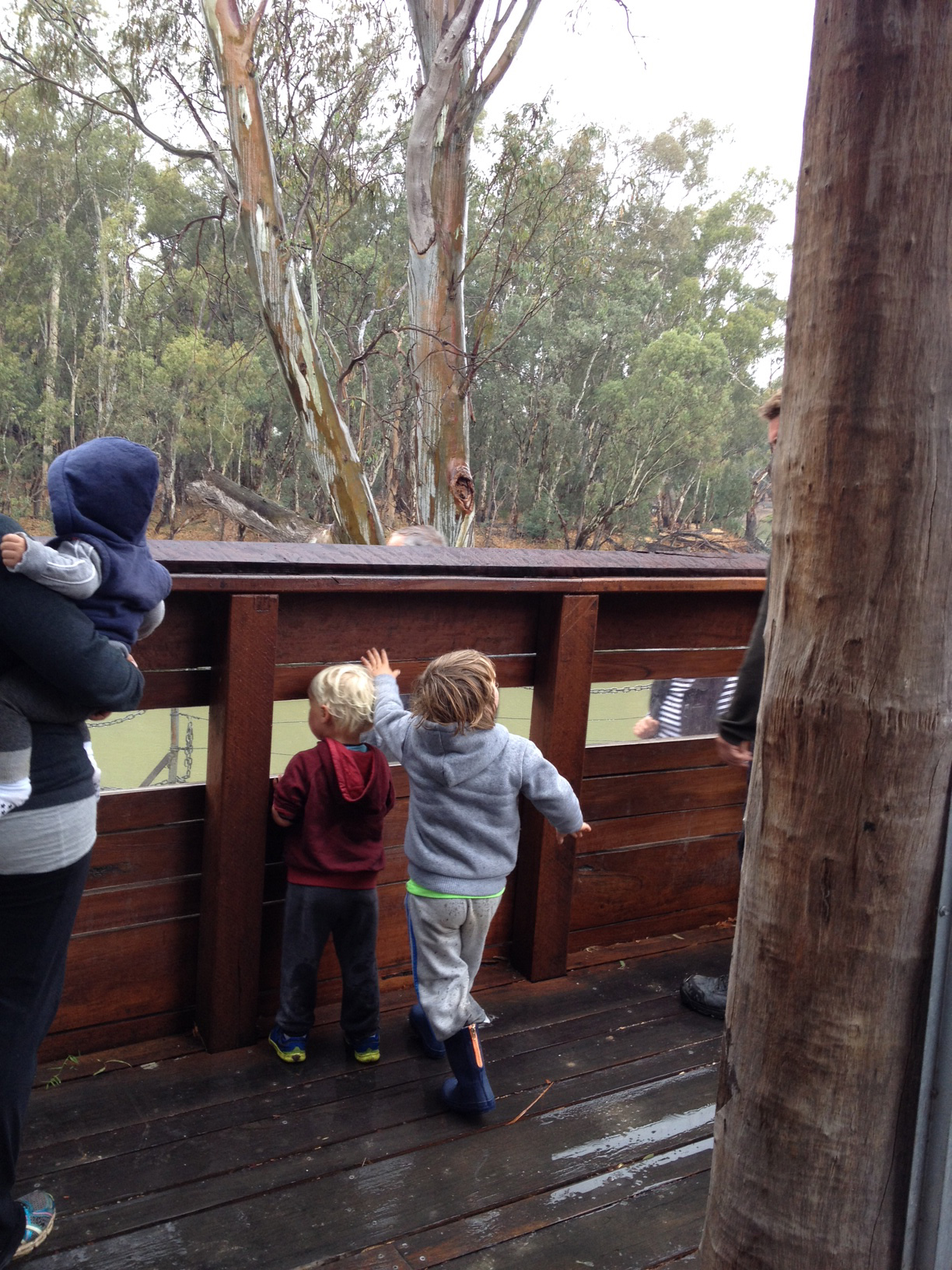
It was a rainy day yesterday as we were walking around the Port of Echuca.  It is the home of the largest collection of working paddle steamers in the world. Daily they paddle up and down the Murray river. At one point along the dock you can walk onto a section that looks out over the river. There is a protective fence where the designers have simply, but cleverly, placed glass panels at “little children” height so that they can look out too.  We were there as two small boys, fresh from jumping in puddles, saw these windows, raced up, looked out, and were thrilled by the sights.

If only churches could see this wonderful metaphor. Too often in worship the fences are that high that only the adults can “see” or experience what is going on. For children the service is an hour and 30 minutes of tedium, or they are sent out to “jump in a few puddles” while the adults do the real thing.

Too many churches, in my experience, either ignore the fact that there are children in church or send them out to be entertained elsewhere. There are no “windows” to enable them to participate and adults are often unable or uwilling to hold them up to see over the fence. So the implied message children receive is that there is nothing here for you. In other words, the view, or real worship, is essentially for adults only.

Children are people of God too. Children are called by Jesus as well. Children are in fact a model for us to follow. “Unless you become like one of these …” Too often however, children are left behind a windowless fence and not included and left out of the worship dialogue altogether.  They are not given a position from where they can be part of, experience and participate in the worship of the whole family of God.

Picture 011

The Port of Echuca on a sunnier day with some of its paddle steamers.

What can we do to give children kid high windows from which, they too, can be part of the worship by the people of God? What can we do as worshipping communities to reduce the walls which prevent children from being part of the singing, listening, praying, reading. giving and hearing that is our dialogue with God on a Sunday?

Churches are losing young people in droves.  What are we doing to make worship an unmissable part of their lives?  One part of the answer is to ensure that the child’s place in the community of worshippers is real and appreciated as well as age appropriate – that they can see through the fences. This does not mean that the worship service needs to be “dumbed down”, but it does mean that the worshipping community needs to think of genuine ways in which children, in fact all ages, have a meaningful encounter with their God when the community gathers for public worship.

I would even suggest that if we as adults are more intentional about including children, that is, giving them “windows” and holding them up, that we too will be enriched by the process. Moreover, and most importantly, God will be honoured and worshipped with greater integrity, as all His children gather before Him.

Categories: Child Theology, Children | Tags: , , | 3 Comments

Unexpected Expectations!

It still surprises me that I don’t always react as I would have expected. After 6 children and over 40 years of marriage, my wife and I heard the news that (finally) we are going to be grandparents.  We have always told our children that whether they have children or not is their decision and our thoughts should not come into the equation. These decisions are between them and God.

Then we heard over the weekend that we are going to be grandparents.  I have to admit it was a thrill to hear the news.  The level of thrill surprised me.  I can’t even tell you why I am so excited. But I am. I am chuffed!

I suppose some of the reasons are that I believe my daughter and son-in-law will make wonderful, dutiful and loving parents, and the grandmothers, in particular, will make the most overwhelming duo a grandchild will ever meet!  Other grandparents tell me that the best thing about being a grandparent is that at the end of any given day you just hand the child back. The sleepless nights are somebody else’s worry.

At the same time this announcement brought back many frightening memories of when I was a young clueless dad. Being a new parent was both exciting and scary. What do you do with them and how do you do it? Babies are such frail helpless creatures and I remember being a helpless lump. By the sixth I think I got over it.

However, I remember clearly the most overawing  words that were spoken to us when we were expecting our first child came from our pastor. He reminded us that when a child is conceived it is conceived for an eternity and as parents we must do all we can to ensure that it is an eternity in the presence of God.

And I suppose that is the other reason for the thrill. When a child is conceived it is a another creation reflecting the image of God – which it will do perfectly, in Christ.

Categories: Children, Family, Uncategorized | Tags: , | 4 Comments

Words Jesus Didn’t Say

Then people brought little children to Jesus for him to place his hands on them and pray for them. But the disciples rebuked them.

Jesus replied, “Send the children around the corner to a children’s program that one of my lesser disciples is running. She will look after them.”

Categories: Child Theology, Children, christian | Tags: , | 7 Comments

When they see among them their children …

20130425-165731.jpg22 Therefore this is what the Lord, who redeemed Abraham, says to the descendants of Jacob: ‘No longer will Jacob be ashamed; no longer will their faces grow pale. 23 When they see among them their children, the work of my hands, they will keep my name holy; they will acknowledge the holiness of the Holy One of Jacob, and will stand in awe of the God of Israel. 24 Those who are wayward in spirit will gain understanding; those who complain will accept instruction.’

Isaiah 29 22-24

These verses come in the midst of God’s frightening judgement upon Jerusalem before Judah’s exile in Babylon.  In contrast to the prophecy of the horrors to come, the passage quoted looks beyond this time of exile to a future when there will be joy and genuine awe in the worship of God.

Many commentators when considering this passage jump on the word “children” and translate that as “future generations”.  There is no problem with that, except we lose the critical idea of being a child and the uniqueness of childhood. Too often commentators suggest that we are dealing with a generation of adults in the future. This, in my view, waters down the intent of the passage.

But why does Isaiah/God use the word “children”?

Which parent has not on occasions sat back and quietly mused on the joy of their children – their exploits, wonder, faith and accomplishments. Our hearts are warmed in the knowledge that they are products of our union! I know there are moments when the opposite occurs but let us stay with the positive for the moment. Children are a symbol of amazing potential and promise. In this passage they are reminders and metaphors for naïve and innocent wonder at the character and actions of God.

Children can remind jaded adults of the joy of the discovery of faith and the wonders of God and His creation and most important, the relief and exhilaration of salvation. They are God’s “sacrament” (symbol or image if you prefer) of new faith, new hope and new future – a crucial idea in the passage above.

In the Isaiah passage children are prophecies of awe filled worshippers (in the fullest sense), of God.

I believe this passage is pointing to Christ but also to his second coming when we will see, completely, how all things will be made new. In the meantime, while we wait for the return of the King. Our children are still heralds of faith and future. We jaded, cynical and worldly-wise adults need to make sure that we do not squash that vision in our children  – or our own hearts.

Categories: Bible, Child Theology, Children, christian, Christianity, Church, Uncategorized | Tags: , , , , | Leave a comment

A Dream for the Spiritual Health of Our Children

skate board ramp“We dream of a local church that is willing to radically rethink what it means to worship God together in ways that are meaningful across generations. This wouldn’t mean simply tweaking  our current elements of worship to make them more child friendly, and it wouldn’t involve the juvenilization of the church. Instead it would mean turning committed disciples of all ages to worship God together. As the contemporary world brings new ways of thinking about and doing church togther, we hope this is part of the agenda.

In her book Welcoming Children, Joyce Mercer asks, “what would happen if, instead of removing children for not conforming to the styles of worship comfortable to adults, we changed some of those styles to invite the fuller participation of children?” We imagine Jesus would answer  this question by taking a child into his arms and saying,”The kingdom of God belongs to such as these.” Will we follow our teacher?”

Children’s Ministry in the Way of Jesus, David M. Csinos and Ivy Beckwith, IVP Praxis 2013, p 125


Categories: Child Theology, Children, Church, Faith, Family, Uncategorized | Tags: , , , , | Leave a comment

The Voice of Inspired Youth

A  few weeks ago I went to an evening church service where two of my students were going to preach for about 20 minutes each.  These likable lads are not always mature or wise in their decisions and behaviour – but they are great young people.

To be honest, even though they are talented young men I didn’t expect too much from them in their first sermon. I was wrong! These lads spoke/preached and delivered the word of God with a passion, zeal, maturity and sophistication. They wove Scripture upon Scripture to declare God’s word to the congregation. Like any good preacher should – they spoke for God.

I reflected later that I heard more of God’s word in these 40 minutes than I had in many so-called sermons in other churches in recent years. They did not delve into pop psychology, glib jokes and puerile anecdotes. Their aim was not to tickle ears but to speak a word that was on their hearts to the heart of the congregation.

I went home humbled. God spoke to me that evening though two of my students. God reminded me that young people have a place, purpose and word to speak in the lives of our congregations. He has gifted all of us, not just the “mature”.

Categories: Child Theology, Children, christian, Christianity, Church, Faith | Tags: , , , | 1 Comment

Helping Our Children Grow in Faith – a review

keeleyOver the years I have become reticent about recommending books as I have discovered that books often resonate with a person because of the time and place they are in individually. However, I will overcome my reluctance and challenge Christian parents, teachers and Children’s ministry workers to read “Helping Our Children Grow in Faith” by Robert J. Keeley (Baker Books 2008).

Essentially Keeley unpacks 6 principles that he believes (and I concur) are important in nurturing faith in children.

  • Children need to be nurtured in their faith by the whole community of faith, not just parents.
  • Children need to be part of the whole life of the church.
  • Children need to know that God is mysterious.
  • Bible stories are the key to helping children know a God who is mysterious and who knows them for who they are.
  • Faith and moral development are both important but they are not the same thing.
  • Children should be part of congregational worship and they should have opportunities to experience developmentally appropriate worship.

Not only are these 6 points beautifully unwrapped but a lot of the incidental teaching along the way is very valuable too. For example, when discussing the power of story, he touches on the danger of simply attaching morals to Bible stories. He suggests that if we simply connect a story to a moral (“Dare to be a Daniel or David” – my examples) we prevent children pondering what God may be teaching them.

He also reflects on a passion of mine: children in worship. He says, “For children to have the kind of faith we want them to have, they need to be part of the worship experience.” Here I would like to have seen, at least, a mention of the impact that children have on the faith of adults as they can inspire us with their naïve simplicity.

Overall, an excellent book that is worth reading, re-reading and discussing with family, colleagues and congregation so that we can all assist in the nurturing of that all import faith in the most vulnerable in our families, schools and churches.

Categories: Book Review, Child Theology, Children, christian, christian education, Christianity, Church | Tags: , , , | 1 Comment

Our Inner Child

When our inner child is not nurtured and nourished, our minds gradually close to new ideas, unprofitable commitments, and the surprises of the Spirit. Evangelical faith is bartered for cozy, comfortable piety. A failure of nerve and an unwillingness to risk distorts God into a Bookkeeper, and the gospel of grace is swapped for the security of religious bondage.
“Unless you become like little children …” Heaven will be filled with five-year-olds.

Brennan Manning, The Ragamuffin Gospel

Categories: Child Theology, Children, Reflections | Tags: , | 3 Comments

Blog at WordPress.com.