Church

Faith in the West

There are times, many times, when I become despondent about the Christian faith in the west.  From its “me” centred  individualism and rampant selfish lifestyle, to glib culturally hip media presentations replacing authentic worship, and onto its lack of cutting edge into the 21stC mindset, there is much to depress me.

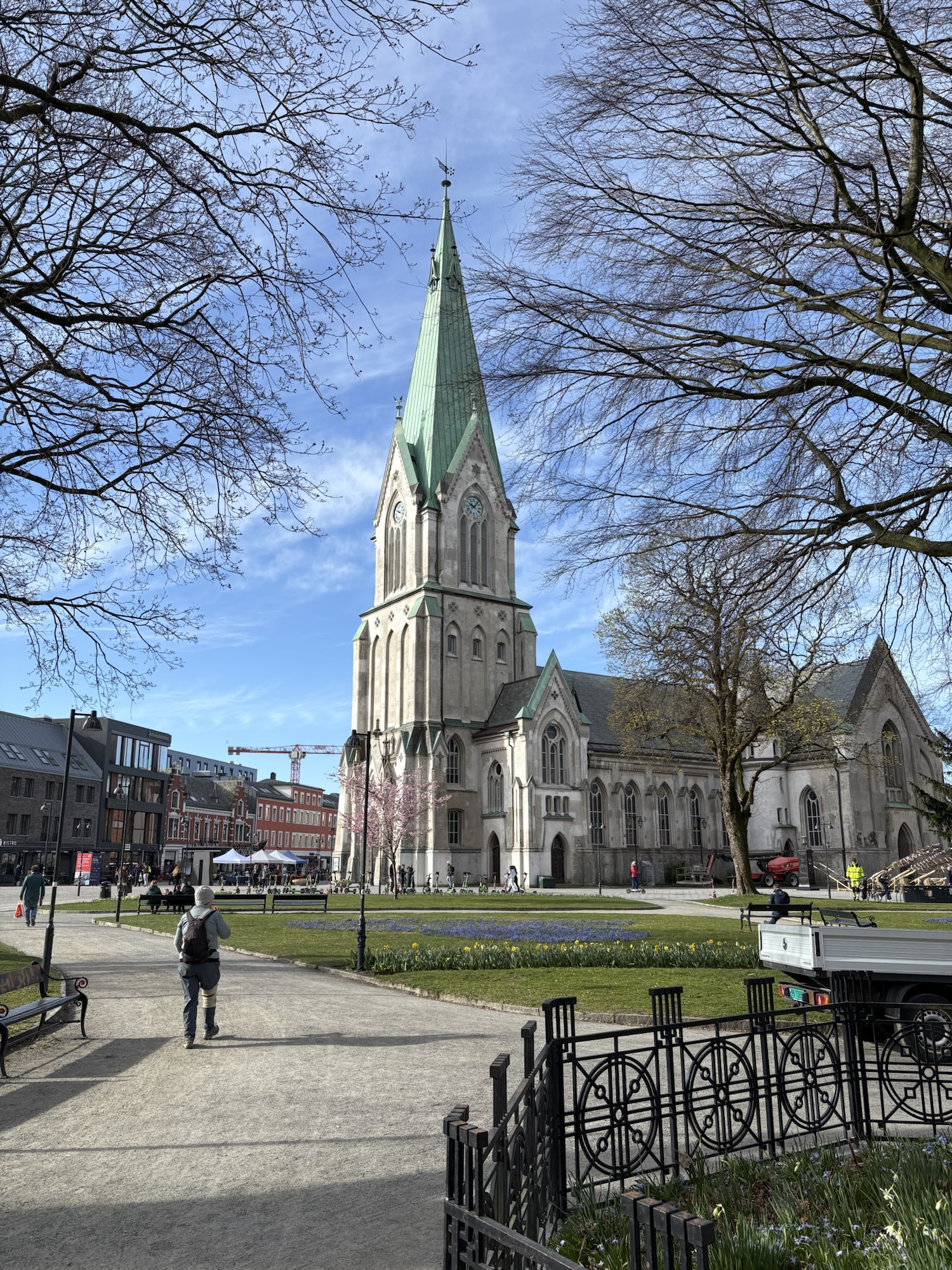
On Sunday we had a breath of life. A glimpse of the past and a possibility for the future. We attended a Lutheran church in Brønnøysund on the west coast of Norway – exactly halfway between the north and south. It was Palm Sunday and the children were incorporated into the service with palm branches. They presented the congregation with songs they had learnt for the occasion. There was also a baptism. Both mother and baby were dressed in traditional costumes. The church was full and there was a clear “buzz” of joy in the congregation. There was not a data projector to be seen. Psalters were handed out. Grandchildren hugged grandparents, friends greeted each other warmly and overall, there was a warm conviviality. It was clear that Jesus was present in the songs, words and attitudes.

It was an environment that a neighbour could be invited to. When an old man using a walker came in, a person vacated their seat, another got a cushion and a still another made sure he sat down safely. “Pastoral” care was obvious.

What have we lost with the obsession for mega churches, CEO’s and business teams running churches with smooth efficiency and ice cold hearts. It is difficult in these environments to share the highs and lows of life’s journeys and to celebrate and grieve together as the family we should be.

Am I just being a grumpy old man, or have we lost something, something precious, in our modern worship practices?

Categories: Children, christian, Church | Tags: , , , , | Leave a comment

Parenting Children for a Life of Faith – Helping Children meet and know God: Rachel Turner, a review

Parenting Children for a Life of Faith – Helping Children meet and know God: Rachel Turner. Bible Reading Fellowship 2018

I am always on the lookout for resources to assist Christian parents in the amazing but terrifying task of discipling their children in faith. The good news is that I have come across two related resources which I can heartily recommend. One is a book and the second is a video series. My strongest encouragement is to get involved with both, but I know (as an ex-English teacher) that there are reluctant readers out there in parent land, so the video series is a minimum!

The Book:

Parenting Children for a life of Faith by Rachel Turner. (This is available from Koorong and Book Depository in an omnibus edition which includes Parenting Children for a Life of Purpose & Parenting Children for a Life of Confidence – (I haven’t yet completely read the latter two).

The Book: Parenting Children for a Life of Faith has the by-line “Helping children meet and know God.” The book includes chapters on modelling a relationship with God and countering wrong views of God. The chapter “Chatting with God” deals with the idea that our relationship is not just meant for set times of reading the Bible or devotions but is an all of life activity. I found this chapter particularly helpful although I would have liked to see a greater emphasis on Bible reading with regard to “hearing” from God. With that quibble aside it is very encouraging. There is also a separate chapter on more “formal” prayer. Another chapter that was very helpful was entitled “Surfing the waves” which is about making the most, as a parent, of the opportunities that arise in the ebb and flow of your child’s spiritual growth.

Other chapters include “Helping children engage with church” and “Starting well with under-fives.”

In part 2 of the omnibus she has a chapter on telling your children the whole gospel story from a young age. She adds examples as to how this can work. This, she suggests, helps children to make sense of the world and its brokenness from a young age. This important idea deserves an article/review just on its own as I found it a good antidote to the, often piecemeal, manner in which the gospel is presented to children.

Overall, I found the content to be practical and Biblical with an abundance of helpful examples. It is a book I wish I had had when I was a younger parent.

The Parenting for Faith Video Course

Rachel Turner also presents a (free) 8 part video course on the same topic. https://www.parentingforfaith.brf.org.uk/ For a sober lad like me her exuberance is sometimes overwhelming, however, putting that aside it is a very valuable resource. There are also downloadable handbooks available to lead you through the course. It is the type of course where it would be very valuable to meet with a few like minded parents and do it together over 8 weeks.

In an era where there are so many “attractions” vying for the heart of your child, here is a book and a video course which can develop your parenting skills in that crucial and eternally relevant arena of faith development. Parents of faith want their children to engage in a life under the Kingship of Jesus from the earliest possible moment.

Pieter Stok

Categories: Child Theology, Children, christian, christian education, Church, Faith, Family | Tags: , , , | Leave a comment

Internet Worship – Observations

During “lockdown” my wife and I attended a variety of church services around the globe via the internet. For example, we valiantly slogged through 1&2 Samuel with Alistair Begg. Since then, we have regularly visited churches to explore how the family of God is worshipping Him. It is encouraging to see people continuing to encounter and praise God, and give thanks for His son 2000 years after his death and resurrection. There is much to be thankful for.

Saint Pierre Cathedral, Geneva

However, there are a few reflections I wish to make:

It surprises me that many worship services do not have an obvious “Call to Worship” – the idea that it is God who calls his children to gather. A Call to Worship reminds His children that they are responding faithfully to their God and that He is the centre and focus of worship. We are giving Him the “Worth” (from the old English worth-ship) he is due. He commences a dialogue to which we respond with hymns of praise and confession, and prayer. However, too often I see services that commence with “I” songs – songs about our experience and feelings.  These are appropriate in the right place, but they don’t clearly focus our attention upon God. Even the corporate “we” is often missing – the songs indicate a lot of individuals in one place, rather than the family of God.

Another observation is that most services have difficulty incorporating children. Family worship is, if we are truthful, adult worship with a few poorly timed nods at the children, at best. Often, the children are disregarded altogether. All age family worship which includes the sermon, is a hill too high to climb for the vast majority of churches. Children are often hived off to “age appropriate” worship. That children should be taught is not the issue. If worship is the gathering of God’s family before God, then children should be included and involved too. Age and maturity appropriate teaching can occur at other times for every age in the congregation in whatever way you want to dice and slice the congregation.

My third observation is there is often an emphasis on personal salvation but not the Kingdom of God. There is little emphasis on proclaiming, revealing, living in and expecting the Kingdom. The “already” (revealed in Christ)  and “not yet” (not fully realised until his return)  Kingdom seems sadly irrelevant to most preachers. The reason this bothers me is that a lack of Kingdom preaching empowers a continued dualism in Christians. Life is divided between the religious and the secular and we are subtly encouraged to live this schizophrenic life.

If you have encountered churches where these issues have been addressed, I would love to hear about them and “visit” them.

Categories: Church, Uncategorized | Tags: , , , , , , , , , | Leave a comment

“I think women are foolish to pretend they are equal to men. “

“I think women are foolish to pretend they are equal to men. They are far superior and always have been.” William Golding (author of Lord of the Flies.)

A few days ago I posted the above quote on my Facebook page as whimsical nudge at some men who lord their ‘superiority’ over women. As a father of 6 intelligent women of whom 4 are contently unmarried, and the husband of one strong wife, I have learned to see life from a different perspective. As one who was once considered a male chauvinist by his fellow high school students many years ago, I have had a long learning journey.

Conservative churches often highlight the role of the stay-at-home mum caring lovingly for her children and supporting her husband. That is what my wife did in our family, as well as volunteering in arrange of organisations, from church ministries to toy libraries with time that was left over. She strongly believed that was her calling.  I hasten to add that there are many women who would like to do that, but economic necessity has made it more difficult.

But conservative churches haven’t been good at celebrating singleness – particularly single women. The apostle Paul writes about it very approvingly in 1 Corinthians 7. Singleness is a gift that can be used in our Kingdom mission. It enables a focus on God’s calling. However, churches have often found it hard to work with this ‘celebration of singleness’. Male dominated church councils have kept women at arm’s length and have seldom created or developed positions that these women could fill.

My daughters all love and serve the Lord and his kingdom but none do it in the denomination they grew up in. One has been an elder, another is a deacon, still another is committed to Christian education but all this outside their denomination of birth. This is both a cause for happiness and sadness. Happiness because they are serving God, sadness because the church that baptised them has no real place for them.

Yes, we all have equal value in the eyes of God but women who have sought to live by Biblical values and not feminist tropes have had to have a higher standard of grace to withstand apathy and rejection.

Categories: Christianity, Church | Tags: , , , , , | Leave a comment

“Everyone Who Loves and Practices Falsehood”

I first wrote this over 10 years ago. Reflecting on it, I thought it was worth reposting.

Blessed are those who wash their robes, that they may have the right to the tree of life and may go through the gates into the city. Outside are the dogs, those who practice magic arts, the sexually immoral, the murderers, the idolaters and everyone who loves and practices falsehood.  Rev 22:14 & 15

Every now and then as I am reading the Bible a phrase or word jumps out at me. It may be something that I hadn’t noticed or reflected on before. In our staff devotions at school Revelation 22 was read and I closed my eyes and listened. I have read or heard this passage on many occasions and reflected on it. However, this time, the phrase “everyone who loves and practices falsehood” made me sit up and take notice.

We live in a world of “spin”. Politicians, companies and celebrities hire “spin’ experts – people to put the “right” perspective on an issue or dilemma. “Spin” is the key to advertising and promotion. I think we could rightly say that “spin” is part of everyday life.

I remember, years ago, attending regular meetings of church leaders and we were called to report on our individual churches. Looking back in hindsight, there was a lot of “spin” happening. Despite issues in the churches, in this public forum we put ourselves in the best light. We do it as individuals as we try to make ourselves look good, knowing all the while, that in reality we are hiding the truth.

A friend once reflected, after a visit to Holland, where one can look into the front rooms of nearly every immaculately presented house, that it reflected his family. The front room, in this case the way his family appeared, was tidy and well kept, but in the back rooms there was chaos anger, lies and pain.

As a culture and society we have become very able practitioners of falsehood. As individuals and churches, we too have been, unthinkingly, drawn into these practices. Why does Jesus include falsehood with idolaters, murderers and sexual morality?

The child of God is the representative of truth. We are called to stand in direct opposition to the enemy, “the father of lies” (John 8:44). John writes “We are from God, and whoever knows God listens to us; but whoever is not from God does not listen to us. This is how we recognize the Spirit of truth and the spirit of falsehood. (1 John4:6)

The Church and the Christian can have no place for “spin” or subterfuge. The world needs to see what truthful lives look like. That also includes honesty when we have mucked things up. Seeking forgiveness is far more constructive (and painful) than spin. The media, quite rightly in my opinion, has highlighted the falsehood of the church. It can only do that when we have not been true to our God of Truth. Rather than blaming the media we should look carefully at ourselves.

For me, this is a tough call. I don’t like being found out. More important though, is my desire to be more like Jesus. The Word tells me that when I know Jesus I “… will know the truth, and the truth will set (me) free.” John 8:32

Categories: Bible, christian, Christianity, Church, Devotional | Tags: , , , , , , , | Leave a comment

The Census – Religion and Australians

The recent Australian census results have revealed that fewer Australians than ever before have stated that they are religious. How should the Christian Church take that message? A slap in the face? A challenge? A cause for reflection? A sign of the times?

Probably all of these.

The church has been “on the nose” for a while. Abuse of children, high-profile pastors abusing their position and other bad press have all been on a steadily growing the list of Christless behaviour.

However, in all this, we should not lose sight of the faithful adherence to the gospel and its calling by many who have quietly, worshipped God, cared for, served and loved their neighbour as an outworking of their faith in Christ – people who have faithfully served and loved despite the appalling behaviour of some.

However, that doesn’t mean there is not much to repent of and seek forgiveness for.

For many decades, if not centuries, church adherence has been tribal. As Michael Jensen pointed out in a recent article (https://tinyurl.com/y93hc8pa) different tribes belonged to different churches. Scots were Presbyterian, and Irish, Catholic and so on. This demise is not something to cry about. It was too often more about a culture and ethnicity, than Christ. Today we see something similar in the US with belief and politics morphed in a very unholy collaboration. A return to a church that is fundamentally anchored in Scripture is to be encouraged and applauded.

Also, Barny Zwartz points out in The Age,(July 10th) ( https://tinyurl.com/4rnuxjww )  “We don’t yet have full figures for the 2021 Census, but in 2011, when 6 million Australians claimed no religion, only 59,000 identified as atheists. There were more Jedi knights.” The point is that people are reluctant to disavow a belief in the existence of a higher being yet they have, as Michael Jensen points out, opted out of the club the family may have belonged to in the past.

Zwartz also compares the census data with the National Church Life Survey, “Research by the National Church Life Survey shows that by far the most hostility to Christianity comes from people aged 50 to 65 – as director Dr Ruth Powell observes, the people who hold the microphones right now. NCLS research suggests that only 21 percent of Australians go to church at least once a month – but that figure rises to 32 percent among 18 to 35-year-olds.” There are points of light and hope in these figures.

The census is, however, a cause for reflection. What does it mean to be church in C21st Australia? How do we reflect Christ and His Kingdom in a winsome way? How do we represent God and the gospel in a way that encourages Australians to think beyond the tribal connections of the past and to reflect on the true meaning of life in a way that honours the God of eternity? Also, how do we repent genuinely, for the poor behaviour of the few who have dishonoured the name of Christ so publicly, while acknowledging humbly that none of us live as Christ calls us to live?

This is a challenge. How do we convince people they are spiritual beings with a soul as well as a body and that in this life, and the next, there is a God who desires the best for them and calls them into a relationship with Him?

Categories: christian, Christianity, Church | Tags: , | 1 Comment

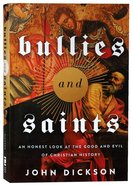
“Bullies and Saints” – a review

Book Review: Bullies and Saints

Bullies and Saints: An Honest Look At the Good and Evil of Christian History Paperback

John Dickson, Zondervan Reflective

Bullies and Saints” tackles the ticklish question of the role of the Christian faith throughout the last two millennia. The subtitle of the book is: “An honest look at the good and evil of Christian history.” It tackles the accusation often made by atheists and others that the world would have been better off without the Christian faith. Which is a thought that has possibly crossed many of our minds. Religious wars, the Inquisition, and more recently the atrocious abuse of innocent children by clergy has all, understandably, fuelled the fire of antipathy towards the Christian faith.

Dickson, as a trained historian and theologian, carefully combs through the history of the church and sorts fact from fiction. With meticulous detail goes through many historical events. He openly acknowledges that which is evil, without excuse, but also highlights the many good things that Christianity has given to the world.

An interesting tack that he takes is that he also looks at “atheist” history and reveals the enormous atrocities perpetrated by unbelieving rulers such as Hitler, Stalin and Pol Pot, that causes any “Christian” barbarism to pale into the background. Dickson also clarifies inaccurate historical perceptions. For example in the historical imagination “The Inquisition” was one of the great historical evils. The fact is that over the 350 years of the Inquisition fewer than 5000 people died. Not that this is excusable but the truth is often vastly inflated. Fascinatingly, it was probably the Protestants and their propaganda against the Roman church that was largely responsible for this inaccuracy.

One of the refreshing aspects of this book is the way he looks at the doctrine of the “Imago Dei” – the image of God in humankind – and reveals how this has impacted our understanding of the value of life. This doctrine has, for example, been central to the development of charities, public hospitals, the anti-slavery movement from the early years of the church and in turn, has been incorporated into modern civilised societies.

His chapter on child abuse within the church is short but pointed and he acknowledges that this dark stain has caused a huge mistrust of the church which will take time and effort to redress. He shows clearly how this is a betrayal of Christ and the gospel.

In the final chapter he points us back to Jesus Christ and the importance that Christians follow him in faith and action. He also adds, ironically, how some atheists now acknowledge the importance of the Christian ethic for healthy society to function.

This is a valuable book as it enables us to put Christian history into perspective. It will assist Christians in honest discussions with non-Christian friends and colleagues. It also reminds people of faith that our motives  must always be guided by Christ and his word. Waver from that and all sorts of traps await.

Categories: Book Review, Christianity, Church, History | Tags: , , | Leave a comment

The Church in a Pandemic

Here is a piece written by my wife Hetty reflecting on the church in our current time.

What happens when a church/ faith community/ group of believers, find themselves in the world of Covid 19?This is a question that I’ve been stewing on for 8 months. In March and April I kept my ears and eyes open for evidence that believers were mobilised to give assistance wherever the need was. I also wanted to see how churches were adapting their services to the challenges and opportunities of ‘online’.

At first I noticed the Sikh and Muslim communities making and delivering meals for tertiary students who had lost their income. I saw that churches were moving online but it was a poor attempt to replicate the service as close as possible, losing much of the sense of personal connection. Some church leaders tried bizarre stunts to continue certain practices.

Closer to home I heard of the work a group of Christians, which included my daughter, was doing to provide meals to the homeless and hungry. To change the sit-down meal they offered in the past with a takeaway one. Our local Christian school is using the produce from their horticulture unit to make meals and fresh food hampers for families who are having difficulty making ends meet.


Yesterday I stumbled across an article about the pandemics of the past. It explained the advancement of the early Christian church during and following the Antonine and the Cyprian plagues that occurred in the Roman Empire of A.D. 165 – 262. The combined pandemics’ mortality rate was anywhere from one-quarter to one-third of the empire’s population.


So what caused the baby Christian church to become a significant religion?Here’s a different way of asking this question: What was God doing in the hearts of the believers? How was He resourcing and equipping them?This is a quote from that article-
“Rodney Stark, in his seminal work “The Rise of Christianity,” argues that these two pandemics made Christianity a much more attractive belief system.While the disease was effectively incurable, rudimentary palliative care – the provision of food and water, for example – could spur recovery of those too weak to care for themselves. Motivated by Christian charity and an ethic of care for the sick – and enabled by the thick social and charitable networks around which the early church was organized – the empire’s Christian communities were willing and able to provide this sort of care.Pagan Romans, on the other hand, opted instead either to flee outbreaks of the plague or to self-isolate in the hope of being spared infection.”


Ah! There it is. Charity.


But where are the majority of today’s Christians to be found? Fleeing the outbreaks? Self-isolating? Pretending that nothing’s changed? Trying to get modern technology to ensure the congregation can continue to tithe? Demanding that the government leaders allow their churches to meet in person again?
Or living out the commandment of Jesus to “Love the Lord your God with all your heart and with all your soul and with all your strength and with all your mind’ and ‘Love your neighbor as yourself.”(Luke 10:27)


I don’t want to search for this. I want it to be so, so patently obvious that a blind man couldn’t miss it. I want people to say “Christians? Yeah, there they are….. using their facilities to cook meals……..providing shelter………helping those struggling with anxiety………using their charitable networks to distribute aid.”
The twenty first century Christian has been equipped by God and He has given each of us a particular task that we must undertake where He has placed us.
Right now we find ourselves in a pandemic.

Categories: Christianity, Church, Hetty's Devotions | Tags: , , | 3 Comments

For a Time Such as This

How has God been preparing the church, the people of God, for a time such as this? And what hints and leadings has He been giving us to be His active representatives on earth right now?cropped-cropped-isaiah.jpg What opportunities has He created? These are all questions my wife has been challenging me with in recent times. Hetty has written the following.

In 2005 we went to live in the UK for 16 months. I found myself with a lot of time and looked about to find something to become involved with. Our local church put me in touch with Bridgebuilder, an organisation that worked with schools to teach children about the Christian faith.

This appealed to me because for 15 years I had been a volunteer teacher of Christian Religious Education in Australia. Every week I spent 30 minutes in each class, sharing Bible stories, and praying with the students. It was a government legislated privilege to be able to do this.

In the UK things were different. The best Christian churches could hope for was to be invited into schools for a few hours every year. Bridgebuilder developed programmes and presented them to a hundred students at a time. I felt appreciative of our Australian system but knew that there was a lot of opposition building against it in the secular community.

Fast forward 5 years and my fears were being realised. The CRE programme was under attack, the organisation overseeing it was scrambling to adapt to the pressures. If the Government removed its protective legislation how would its mission to school children continue?

This was the moment that I thought back to my time in the UK. Could God have given me this experience so that I could now see a way forward in my local situation? Had He been equipping me for a future I didn’t yet know?

Today the universal Church is part of a universal crisis. Alongside health, economics, education, transport, employment, and a hundred other areas of human life, the Church is wondering how it will survive in a Covid 19 world and how it can keep being Christ to that world.

Many Christians and churches are trying to tweak what we’ve always done – drive thru communion, services in the car park while parishioners stay in their cars, and the like. Generally we are hunkering down and looking after our own flock. Missions means going ‘out there’, but we’re being told to stay at home.

But my thought is that God has been preparing His people for a Covid 19 world. What He was doing in your life ten years ago, or five years ago, or last year, was ‘the equipping of the saints’. Cast your mind back.

Look around your immediate vicinity. What appearance does this new world have? How has it changed? Then go back to our marching orders. What is a Christian’s primary mission, and what equipment and training have we been given by God to carry it out?

One example is the scandal of child abuse that has rocked the Church. The Church has become a stench to the world, and often it is trying to make excuses for the actions of its own people, desperately trying to salvage its reputation. I cringe whenever this issue is raised. I want to hide in shame.

So how should we view the sequence of events in our time with the idea that God is using them to equip us? And how do we move forward into the future with this massive millstone around the neck of the Church?

I believe God can and will advance His kingdom in spite of the wickedness of mankind. Abusive churchmen and women cannot thwart His plans. Perhaps the Church needs to fall on its knees, confess, repent, and seek forgiveness from those it has harmed. Never seeking a lenient sentence, but accepting judgement, and giving all it owns (every last gold goblet!) in restitution and compensation. A broken and contrite heart. Personally, I am waiting for the leaders of our churches to start this process.

Then we can be used by God to …


Categories: christian, Church, Uncategorized | Tags: , , , | 1 Comment

Secular Shariah Law

Hands are are thrown up in horror when people suggest Shariah law may become part of Western democracies with the influx of Muslim migrants and refugees. But I would suggest that there is another Shariah law of which we need to be even more wary.  Slowly over the last decade or so Australia has descended into a state of political correctness and the problem exists for those who may not agree with aspects of that correctness. The nature of ‘political correctness’ is that if you don’t agree you must be ‘incorrect’. The consequences: you become the object of social bullying and ostracised.

One may struggle with the idea of same sex marriage, current views on gender, child rearing and a whole host of other concepts. The problem is that if you don’t agree with the pc majority you and your views are considered unworthy of social acceptance or tolerance. In other words we have entered an era of secular shariah law. Or using a Henry Ford analogy you can have any colour T model ford as long as it is black. Other views are not permitted. If one doesn’t hold the view of the majority in the area of ethics and morality one gains pariah status.

At the heart of a vibrant democracy we need to be able to discuss and debate views in which worldviews encounter each other and can be weighed up. Even in the Cold War era Australia was wise enough not to ban communism. Yet that style of openness has been eroded. Only particular voices are now considered worthy to be listened to. Ironically even media articles arguing for tolerance are intolerant of discordant voices. Most disturbing is that one’s conscience can no longer be a reason for disagreement. The secular Shariah police will ensure that.

And that is the aspect that bothers me most. I understand and accept that with changing social mores many people, indeed most people, won’t agree with me but now, increasingly, many of us are being forced to agree or at least submit to the edicts of the secular Shariah law whether we like it or not.

Categories: Christianity, Church, community, Ethics, Faith, Uncategorized | Tags: , | 6 Comments

Blog at WordPress.com.