Church

Jesus, Our Personal Trainer – Not!

“Are you for us or for our enemies?” “Neither,” he replied, “but as commander of the army of the Lord I have now come.”   Joshua 5:13

Lord’s Day 1 Heidelberg Catechism

1. Q. What is your only comfort in life and death?
A. That I, with body and soul, both in life and death, am not my own, but belong unto my faithful Savior Jesus Christ; who with his precious blood has fully satisfied for all my sins, and delivered me from all the power of the devil; and so preserves me that without the will of my heavenly Father not a hair can fall from my head; yea, that all things must be subservient to my salvation, wherefore by his Holy Spirit he also assures me of eternal life, and makes me heartily willing and ready, henceforth, to live unto him.

Westminster Shorter Catechism

Q. 1. What is the chief end of man?
A. Man’s chief end is to glorify God, and to enjoy him forever.

Window in Chartres Cathedral

Window in Chartres Cathedral

There is a common thread that runs through these three texts, that is, we are here to serve God, not the other way round. In western culture there has been a strong tendency for Christians to treat God as a personal trainer, a guru or spiritual aspirin. In other words God is there to serve us, make us comfortable and look after our needs. We are then massively disappointed and angry when this doesn’t occur. We have turned our Saviour into a servant and Lord into a lacky. We see it in so many sermons which have become “feel good” ear ticklers filled with trite psychology. Prosperity theology and the gold dust idiocy of recent years are just some of the more extreme examples of our tendency to twist Scripture to serve our purposes.

How has that happened? In part it is because we have failed to look at the more comprehensive picture of Jesus. Yes, he is a Saviour and he did come to save us, but he is also a king who has come to reclaim his kingdom. If we forget the second half of this picture it is easy to see how we fall into a self focussed faith.

As Joshua found out as he prowled around Jericho, and David when he was anointed King, and  as Paul declares every-time one of his letters heralds “therefore” and as the Apostle John was enlightened on the island of Patmos, Jesus has a rightful claim on our lives, our service and our obedience, not the other way round. As his adopted brothers and sisters we have been co-opted into the Father’s business which is Kingdom building – rightfully declaring, claiming and striving for Christ’s rule over all things.

Looking at faith from this perspective removes our human tendency to self absorption and spiritual pride. Christianity would have died in the first century if the early church had our modern self centredness. Following Jesus was the cause of their problems not the solution, yet they rejoiced in the calling they had to serve the king.

Between Palm Sunday and Easter is a most appropriate time to reflect that the one who was crucified, rose from the dead as a triumphal King and liberator. We are privileged to be called citizens in this eternal kingdom!

Categories: christian, Christianity, Church, Devotional | Tags: , , , , | 8 Comments

Memories of Church No.4 – Conflict and Conclusions

The last part – for the time being.

As I grew up, particularly in my teen years, I began to realise that Christians weren’t perfect and conflict was an inevitable part of church life. It became obvious that the words and actions of adults didn’t always match, and that motives were not always pure. One became aware of the cliques and groups – people with different attitudes, agendas or values.

In the early 1960s our church had a very conservative, very Dutch minister. In order to attend communion, which was held every three months, you needed to attend church twice a Sunday. My dad, also Dutch and stubborn, had refused to travel to Geelong twice a Sunday after his little church in Ocean Grove had been closed. “If they close my church, I am only going once!” So the scene was set for conflict. Every three months before communion my family would receive “huisbezoek” – a home visit by the elders and minister. I was allowed to attend the formalities: coffee, Bible reading and prayer. Then I was sent to my room. However I could still hear the “conversation” between my father and the minister clearly through the walls. Dad didn’t give in and neither did Dominee K.

As I stated earlier, Dominee K returned to Holland and we had a new minister who simply asked my dad, “Do you love the Lord?” To which my father replied, “Of course!” and so he was allowed to return to the communion table. And my father started going to church, twice on a Sunday!

The arrival of the Pentecostal movement had far more profound effects. The church became divided, some families split and there were married couples who lived in tension for decades to come, with the death of a partner greeted with relief rather than sorrow as it ended an unhealed past. The power of deeply held beliefs to unify is profound, but its power to divide is monumentally tragic.

Looking back, I can now see the attraction of the charismatic outbreak. There was a joy in God and worship, a recognition of the power of the Spirit and an overall enthusiasm for faith and outreach. At the time there were also excesses and extremism. But that was true of both sides. Both groups saw right on their side. I don’t want to enter into the theology of this division at this point but rather consider the attitudes that people held that didn’t reflect Christ. As a young person at the time I was bewildered. How could beliefs, people and values shift so quickly? On the other hand I was in a privileged position as the two key leaders on both sides of the debate had a profound impact on my life. They were both men who loved the Lord deeply. Their followers were not always that wise. Blacks were made blacker and whites whiter. I have come to reflect that we often justify our attitudes by hardening our positions. There are times when we may need to separate or part ways due to deep disagreements but this can still be done with grace and Christ-likeness. This is particularly true when the heart of the gospel is not compromised.

Over 45 years later, I now work in a school where fellow Christians from a wide variety of evangelical backgrounds respect each other’s differences and work together for the common good of Christ’s Kingdom and Christian education. These changes didn’t happen overnight. It took many, many years. I rejoice often that I have lived to see a day when the values of two men I respected dearly have come to coexist and empower the place where I work. More importantly, I believe because of this healthy co-operation, we can see Christ and His kingdom more clearly.

Hah! But that callow youth back in the late 1960s did not have clue of what God had in mind.

Categories: christian, Christianity, Church, Faith, Family, History, my dad | Tags: , , , , , | 2 Comments

Memories of Church No.3 – Methodists and Mayhem

This is part 3 of my early recollections of church.

In the mid 1960’s the church to which I now belonged rented a Methodist church that only had a few members left. After a couple of years we purchased the building and added to our congregation a small number of aged Methodists who refused to leave the building they had been part of for their whole lives. One of the “fixtures” was Mr. Robinson who, in his earlier life, had shown 16mm films in the local schools. He was also an expert on first aid and was always willing to give our youth group demonstrations. As we had Dutch parents and grandparents, Mr Robinson was our connection with the new culture in which we lived.

This was also the time that I was starting to think about the future. God put in a number of factors: there was a teacher who urged me to apply for University, which, as I have explained in earlier blogs was light-years away from my parents’ experience, and there was Rev. Deenick who urged me to explore the concept of Christian education. Rev. D. didn’t hit me with all of that at once but over time we had discussions, and he urged me to read certain books and attend particular conferences and so when the time came, in the then, distant future, I was helplessly drawn into a group of people whose aim it was to set up a Christian school, and ended up being a Christian school teacher.

 At the time it seemed all so “accidental” but looking back Rev. Deenick and God were in close collaboration.

But I am racing ahead of myself. When I look back, being a Christian was a serous matter. It was not about having fun – and I am ok with that. Awe, obedience and doing things the right way were explicitly and implicitly drummed into us.

Then in the second half of the 1960s an upheaval occurred. One of the professors from the theological college (the “house” I mentioned previously) started teaching the doctrine of a second blessing with the baptism of the Holy Spirit*. To be blunt, theological war broke out and my parents were in the middle of it. As a teenager I pretended nothing was happening, after all, even though church was important there were also music, girls, cars and a bit of study to consider.

Little did I know then that this was part of the Pentecostal/Charismatic tsunami that was to hit Australian churches, and whether I liked it or not, I would have to reflect deeply on the Bible and what I believed.

* Both these men, Rev Deenick and Professor Schep, in opposing theological camps, are mentioned under my blog heading: Melchisedeks.

Categories: christian, Christianity, Church, Faith, Family, History, my dad, Reflections, Uncategorized | Tags: , , , , , , | 2 Comments

Memories of Church No. 2 or Coffee, Calvinism and Cigars

Yesterday I started my reflections on growing up in a migrant church in the 1950s.  Today the story continues …

By my mid teen years we were worshiping in Geelong. This congregation, which was much larger, did not have its own building yet and had also moved several times – from a Temperance Hall (with amiable rats) to Church Halls. At this time I attended “Catechism classes”, also in relocated army huts. (A story for another occasion involves the Friday after school Catechism classes held at our home. But that deserves a special heading of its own). Previously we had  had Saturday Morning School. Every Saturday morning, (as the name suggests!) the children from Ocean Grove were herded into a windowless van my dad normally used to cart veggies, and were sent to a house in Geelong, which also doubled as a theological college, (these dutchies weren’t shy!) and we spent two hours learning about the Bible, Church History and creation while our Aussie friends played football, tennis or cricket. I must confess they were not my favourite two hours of the week. It was an attempt by  our parents and the church to compensate for the lack of Christian education,  not as I suspected at the time, a form of sadistic adult cruelty.

Around that time, due to the closure of our church, we started attending church in Geelong which had a very traditional dutch minister. When asked what the church was doing for evangelism, his honest reply was, “We open the doors of the church every Sunday.” He soon returned to Holland (and, I believe, to a “black stocking” church) and a new minister arrived who had a profound impact on my life. Rev. J.W. Deenick was a staunch Calvinist who had an amazing sense of the the Christian’s role in the Kingdom of God. With the gift of hindsight I realise that he planted some of that in me.

The church services were just as dull as usual – the hymns sober, the organ slow and not a

Image: Courtesy, Wikipedia

Image: Courtesy, Wikipedia

guitar in sight. I recall on one occasion being reprimanded by my dad for wearing corduroy trousers, “Would you visit the Queen wearing those pants?” “She hasn’t invited me,” I thought but didn’t dare express.  However, now with the new minister there were activities to get involved in; Holiday Clubs (or Vacation Bible Schools) to run and Beach Missions to organise during the summer. For a keen teenager this gave purpose to a Christian’s life. Looking back, it was a time when we began to shed our ethnic hangups and sought to become part of Australian society and bring our own unique contributions: coffee, Calvinism and cigars – not necessarily in that order.

All the while we still had our dreaded catechism classes after which followed the more enjoyable youth club time with its topical studies, business meeting and games – as well as meeting girls. This is where I discovered my wife – after a few false starts!

Tomorrow I want to explore my entry into Christian education.

Categories: christian, Christianity, Church, Faith, Family, my dad, Uncategorized | Tags: , , , , , | 1 Comment

Memories of Church No 1.

Some of my earliest memories centre on Church. In our small migrant community in Ocean Grove during the mid 1950s, our kitchen was the biggest room. So every Sunday the Reformed people would meet at our home. Sometimes a sermon was read and on occasions a visiting preacher would do the honours. My dad played an asthmatic reed organ that he had rescued from somewhere – possibly the tip.  He also  loved the once a month communion service because the bottle of left over wine was passed on to him – a real treat at a cashed strapped time! I imagine his only regret was that cigars were not part of the service!

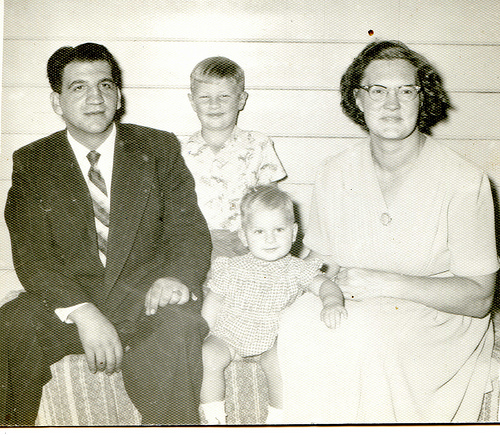
Our family in that kitchen in about 1957. N.B. I was a blond in those days.

Our family in that kitchen in about 1957. N.B. I was a blond in those days.

When the community grew in size we moved to the “Methodist Camp” which had a hall large enough to accommodate the growing community. My brother was baptised there as a baby in 1956. Later it was the Anglican Church Hall. A time came when we built our own church building over the road from the Primary School. A disused army hut was moved on site and as funds became available it was rebuilt to serve as a multi use hall. The kids were able to help by carrying and painting and serving cups of tea and coffee.

However by the mid 1960s most of the dutch migrants had moved closer to Geelong and to places of work. The church closed and the building was relocated to another town for another small congregation.

This period of time, at the most encompassing 12 years, has warm memories for me. The overwhelming sense is one of community and cooperation. “New Australians” needed each other as they coped with the massive issues of arriving in a new land. For a while we shared a car with one of the other families. People helped each other out and the church building was just a small example of a bigger attitude of selfless service. When babies were born the rest of the children were farmed out – this was so “usual” for us and it was fun to have new brothers and sisters for a week.

This was my first memory of church. It was what I thought church was about. Years later as wealth entered the community and people became more independent something was lost.

But I like to dream. I remember the time when people walked from all corners of Ocean Grove just to come to our kitchen. I remember the laughter as the adults drank coffee and smoked (sorry – I have to tell the truth!) after the service. There were all these friends I could play with and we could take walks near the marshes along the river. That was Sunday and that was church. When I got back home and everyone had left I would find dad settling down with a glass of wine, and a cigar – if he was lucky.

Categories: christian, Christianity, Church, Faith, Family, my dad, Uncategorized | Tags: , , , , , | 6 Comments

Providential Intersections

Lately I have been dipping into a book, “The Piety of John Calvin” by the foremost Calvin scholar and translator, Ford Lewis Battles. It is delight to read and casts a wider and more human/humane picture of Calvin than we often read. (If you are obsessed with the Calvin and Servetus controversy I suggest you read the excellent work listed below).

Picture 1159 cropThis book has an extra level of joy and that is the providence we see in its pages – the hand of God at work. Battles was a Rhodes scholar who went to study at Oxford in the 1930s. One of his teachers was none other than C.S. Lewis who introduced him to the classics of theology. Battles stated that this led to a “rebirth into faith all too imperfectly received in my childhood when I was sent to the early Christian fathers by my academic supervisor, C.S. Lewis of Oxford University.” (p11).

Battles died in 1979. “The Piety of John Calvin” has since been republished with a preface by his daughter, Nancy, who describes her father’s pre-laptop computer attempt in developing a well catalogued version of Calvin’s work and that his effort to do this well was inspired by the medieval monks who spent a great deal of effort producing handwritten and illuminated works.

I hope to write more about this book in the future but my question for today is a simple one. Are we aware of the saints who preceded us who have shaped and directed our lives? Who has inspired us to do well, to serve well and live well? In an age when “the present” is king and we deify this moment on Facebook, Twitter and Instagram, do we stop long enough to reflect on the positive influences from the past?

These saints of the past may have come to us via books and studies we have pursued. Let us be thankful that God has given us a lineage of influences linked throughout the centuries. For Battles, church fathers, medieval scholars and C.S.Lewis were just some of the intersections that God put along his path.

PS. A balanced article by the renowned scholar Lorraine Boettner on “Calvin and Servetus”: http://the-highway.com/servetus_Boettner.html

Categories: Book Review, christian, Christianity, Church, Reflections, Uncategorized | Tags: , , | Leave a comment

Moralistic Therapeutic Deism

My wife, who is passionate about children’s ministry, introduced me to a study that I had not previously heard about. In 2005 Christian Smith and Melinda Lundquist Denton wrote a book entitled: Soul Searching: The Religious and Spiritual Lives of America Teenagers. (I have to stress, I have not yet read the book only the paper by Smith referenced below.)

After interviewing 3000 teenagers they suggested that there is a “de facto dominant religion among contemporary teenagers in the United States …  what we might call “Moralistic Therapeutic Deism.”

Smith and Denton suggest that there are a number of key beliefs to this creed, namely:
1. A God exists who created and orders the world and watches over
human life on earth.
2. God wants people to be good, nice, and fair to each other, as
taught in the Bible and by most world religions.
3. The central goal of life is to be happy and to feel good about oneself.
4. God does not need to be particularly involved in one’s life except
when he is needed to resolve a problem.
5. Good people go to heaven when they die.

If this research is accurate, and there is no reason to suggest it isn’t, we have a scary, self centred religion among many of our young people. I might add that the noise coming out of many churches is not that dissimilar. Prosperity theology is just one example.

The findings of this research have massive implications for the church: What it teaches, how it teaches and the centrality of Scripture in that task. The five beliefs above are at best half truths and at worst poisonous corruptions of the truth that will stifle and destroy Christian faith and discipleship.

Christian Smith closes his paper by writing:
The language—and therefore experience—of
Trinity, holiness, sin, grace, justification, sanctification, church, Eucharist,
and heaven and hell appear, among most Christian teenagers in the United
States at the very least, to be being supplanted by the language of happiness,
niceness, and an earned heavenly reward. It is not so much that Christianity
in the United States is being secularized. Rather more subtly, either
Christianity is at least degenerating into a pathetic version of itself or, more
significantly, Christianity is actively being colonized and displaced by a quite
different religious faith.

I can’t help thinking that this development describes more than only teenagers. In my recent travels around a variety of churches in Australia I have been astounded how often I have heard pop psychology and “feel good” messages rather than the proclamation of Word of God. A return to God’s Word and its claims on our lives must be the starting point for the rescuing of lives – hearts and minds.

Reference:

Click to access Smith-Moralistic.pdf

Categories: Child Theology, christian, Christianity, Church, Moralistic Therapeutic Deism | Tags: , , , , | 3 Comments

The Morning Star of the C18th Welsh Revival

It is amazing the way that God works. Forces are arrayed against His plans only to be outwitted time and again.

This occurred (once again) in the years leading up to the Methodist Revival in Wales in the C18th. An Anglican minister, Griffith Jones, sometimes referred to as the “morning Light of the Welsh Revival” was often in trouble with his superiors for his unorthodox approaches. Dallimore references him in his biography of Whitefield. For example, Jones preached outdoors when the crowds became too large. This was not the “done thing.” In all, he was too enthusiastic for his times. So the authorities restricted his ability to preach. Now, this could seem like a defeat. However, Jones, undeterred, commenced a series of circulating schools (schools that would remain in an area for a while and then move on). Many thousands of people learned to read and were presented with the gospel through his work. It also provided a wonderful foundation for the revival to come – a wonderful picture of God’s sovereignty.

Griffith Jones is an example of one who sees obstacles as opportunities. Once again, there is a lesson in that for me.

Categories: christian, Christianity, Church, George Whitefield, Reflections, Uncategorized | Tags: , , | 8 Comments

Mentors

What are some of the most beautiful relationships in Scripture? There are many to chose from: Moses and Joshua, David and Jonathan, Jesus and his disciples, Jesus and John, Eli and Samuel, Naomi and Ruth … the list can go on. However I want to reflect on a particular type of relationship, which if we practise, can result in blessing for years, if not generations to come. This important relationship is  the mentor, that is, the older person who takes a younger person under their wing and sacrifices time, energy, effort and most importantly of all, themselves, for the growth of the young person.

20120413-191808.jpgOne of the most beautiful examples (outside of Christ and his disciples) is Paul and Timothy. Timothy, a young man of mixed descent has a faithful mother and grandmother. Paul takes him on his second missionary journey and ultimately places him as a young pastor in Ephesus. Then, despite his imprisonment (at least by the Second Epistle to Timothy) Paul writes letters in which he teaches and encourages Timothy in his important task.

In 2 Timothy Paul calls Timothy “my dear son” and expresses a passionate longing to see him.  We have no record of Timothy’s response but we can surely imagine the wisdom and strength he gained from Paul’s input. As a young man in a tough pastoral environment, having Paul’s backing and support would have been a huge blessing.

Today we live in an era of social and family fragility. Not every young man or woman grows up with healthy role models let alone committed mentors. There is a crying need for “Pauls” (men and women) who are prepared to lead and nurture the young in wisdom. I believe it is a role, no, a calling, the church has today. One way for the church to make a lasting and positive impact is to be “living gospels” to the young, in order that these young people can see, hear and emulate a faith filled and directed Christian life. Then we may say as Paul did,  “You, however, know all about my teaching, my way of life, my purpose, faith, …” (2Tim 3:10).

Categories: christian, Christianity, Church, Devotional, Faith | Tags: , , , | 2 Comments

Through the Praise of Children and Infants …

Through the praise of children and infants
you have established a stronghold against your enemies,
to silence the foe and the avenger. Psalm 8:2

It Is Time To Bless Our Children

Our children are called to praise God

In Psalm 8  David is astounded as he reflects on minuscule man in God’s vast cosmos. “Who are we when the universe is so big!” So the fact that we are a little lower than the angels, and rulers over creation is even more amazing. Humanity is important to God.

But I believe the most extraordinary verse is verse 2. Within the cosmos, the praise of children and infants can silence God’s enemies! The smallest of the small in the vast halls of God’s universe have a place front and centre to bring glory to God.

The praise of Children is close to God’s heart. This Christmas churches will have nativity plays and choirs. However the praise of children to God should be front and centre all year round in church, home and school. Children’s praise is not just for Christmas and Easter.

When our naive and vulnerable children sing praises to God and shake His enemies we have evidence of God’s faithfulness. When we parents, adults and leaders only trot them out at Christmas we are stifling our children and their place in His Kingdom.

Categories: Child Theology, christian, Christianity, Church, Devotional, Faith, Reflections | Tags: , , , , | Leave a comment

Blog at WordPress.com.