Family

The Attic

It was our second last day in the Netherlands. We had been visiting family and driving around favourite and previously undiscovered attractions for two weeks. There was still one final visit – my last surviving aunty in Holland who had been married to my mother’s youngest brother.

My wife and I received an enthusiastic welcome. A cousin and her husband were also present and later a grandson arrived. After the pleasantries, coffee and cake there was a surprise, a box of books, letters, photos and other memorabilia that had been discovered in the house, that many years earlier, had been where my grandparents lived.

The story is amazing! The grandson (about 27) had been showing some relatives (two girls their 20s) around Rotterdam when they asked if they could see the place where their grandfather (my uncle) had been born. When they arrived, the grandson, being polite, knocked on the door of the house and asked the owner if minded if he took some photos of the girls in front of the house. “Not at all,” was the reply, “But maybe you can tell me if a box of material I found in the attic belongs to your family. I was about to take it to the Rotterdam archives.”

So, this is how these 80 to 90 year old treasures came back to the family. There was a wedding photo of my grandparents which included many other family members, letters from a nephew who was in a Spitfire squadron in Indonesia during the uprising in the late 1940s, pension slips, post cards, school books, books that had been presented by church and school to my aunts and uncles, and my favourite, a certificate belonging to my mother for completing her primary education at the “School met den Bijbel”.

This is particularly special because I have been involved in Christian Education in Australia all my adult life, as a parent, school board member, teacher, and now, grandparent. This certificate puts into perspective a history of family involvement in Christian Education. Even today, two of my daughters teach in Christian schools.

Psalm 78 speaks of telling our children God’s statutes, and “even the children yet to be born.” (v6) My mother as a 13-year-old had no idea of what the future would bring. There would be war and migration, but there were also children, grand children and great grandchildren who know God because God’s truth had been passed through the generations.

Driving away from my auntie that night, I had tears in my eyes and reflected how God’s Covenant promises work through generations; one generation passing on the truth to the next. This certificate also signifies the end of my mother’s formal education. She had to go to work to support her family in the years between the depression and the war. More importantly, it is a reminder to me of how faithful grandparents sent their daughter to a school that would support them in their parental task and, generations later, the impact is still felt.

Categories: christian education, Faith, Family | Tags: , , , , | 4 Comments

Parenting Children for a Life of Faith – Helping Children meet and know God: Rachel Turner, a review

Parenting Children for a Life of Faith – Helping Children meet and know God: Rachel Turner. Bible Reading Fellowship 2018

I am always on the lookout for resources to assist Christian parents in the amazing but terrifying task of discipling their children in faith. The good news is that I have come across two related resources which I can heartily recommend. One is a book and the second is a video series. My strongest encouragement is to get involved with both, but I know (as an ex-English teacher) that there are reluctant readers out there in parent land, so the video series is a minimum!

The Book:

Parenting Children for a life of Faith by Rachel Turner. (This is available from Koorong and Book Depository in an omnibus edition which includes Parenting Children for a Life of Purpose & Parenting Children for a Life of Confidence – (I haven’t yet completely read the latter two).

The Book: Parenting Children for a Life of Faith has the by-line “Helping children meet and know God.” The book includes chapters on modelling a relationship with God and countering wrong views of God. The chapter “Chatting with God” deals with the idea that our relationship is not just meant for set times of reading the Bible or devotions but is an all of life activity. I found this chapter particularly helpful although I would have liked to see a greater emphasis on Bible reading with regard to “hearing” from God. With that quibble aside it is very encouraging. There is also a separate chapter on more “formal” prayer. Another chapter that was very helpful was entitled “Surfing the waves” which is about making the most, as a parent, of the opportunities that arise in the ebb and flow of your child’s spiritual growth.

Other chapters include “Helping children engage with church” and “Starting well with under-fives.”

In part 2 of the omnibus she has a chapter on telling your children the whole gospel story from a young age. She adds examples as to how this can work. This, she suggests, helps children to make sense of the world and its brokenness from a young age. This important idea deserves an article/review just on its own as I found it a good antidote to the, often piecemeal, manner in which the gospel is presented to children.

Overall, I found the content to be practical and Biblical with an abundance of helpful examples. It is a book I wish I had had when I was a younger parent.

The Parenting for Faith Video Course

Rachel Turner also presents a (free) 8 part video course on the same topic. https://www.parentingforfaith.brf.org.uk/ For a sober lad like me her exuberance is sometimes overwhelming, however, putting that aside it is a very valuable resource. There are also downloadable handbooks available to lead you through the course. It is the type of course where it would be very valuable to meet with a few like minded parents and do it together over 8 weeks.

In an era where there are so many “attractions” vying for the heart of your child, here is a book and a video course which can develop your parenting skills in that crucial and eternally relevant arena of faith development. Parents of faith want their children to engage in a life under the Kingship of Jesus from the earliest possible moment.

Pieter Stok

Categories: Child Theology, Children, christian, christian education, Church, Faith, Family | Tags: , , , | Leave a comment

One Generation

A while back, my wife wrote a post that has continued to haunt us both – One generation from extinction. It speaks of the urgency of training and nurturing our children in faith – particularly in a post Christian world.

To this end, I am in the process of setting up a website/blog that collects and distributes resources that will enable parents and churches find material that will assist them in this crucial task. I would love to hear of books, websites and articles that have assisted you. Join us at Familyfaith.blog.

Categories: Children, christian, Faith, Family | Tags: , , , , | Leave a comment

In search of victimhood

A reflection from my wife …

The world is changing and I must adapt.

For about the first thirteen years of my life our family played a game called “Not Like Them”. I was reminded daily why we were different (read: better) than our neighbours. We didn’t wear plastic sandals. We had proper lunch boxes, not sandwiches wrapped in repurposed sugar bags. And more.

Of course we weren’t aware that in other ways we were different; ways my mother didn’t want to highlight because they meant we weren’t better.

This comparing took a distinct and particular aspect. It was always about being the best, or at least being seen to be the best. The “them” in our game were the unfortunates, the poor who lived in dirty houses, the kids whose parents didn’t know how to keep house, or wash, or sew.

But now our planet has tilted somewhat. Perhaps it could be said that the world I now inhabit has been turned on its head.

Because we are playing a different game and it’s called “Victimhood”. A race to get to the bottom. Not better than others; we only win if we can prove we are worse off. A victim.

A woman, aged, poor, indigenous, abused, with mental health issues, drug dependency, hidden acquired brain injury, gender dysphoria, gay, lesbian, or trans, on the spectrum, a victim of colonialism, or a tradie who can’t afford to pay his mortgage. Turn over these life cards and you’ll surely be a winner. 

It’s a game I do not want to participate in. The pastime of playing “Not Like Them” which involved looking down our noses at our neighbours, wasn’t very nice either. Is there another way? 

Can we recognise the challenges each and every person faces because of who they are or what life situation they’re in? Can we give a helping hand or a compliment? Can we live together differently because we are all unique? Can we honour one another as we stand together on a podium, not at the bottom?

Categories: Family, society | Tags: , , | 1 Comment

Parenting

Below is an article on parenting that I wrote many years ago … it is still relevant

Categories: Children, christian, Family | Tags: , , , | Leave a comment

Medieval parenting

My wife and I were discussing parenting for faith last night as we often do. We reflected on the perilous social conditions that confront Christian parents today.

I cast my mind back to my own parents who were foundational in their influence on my life, especially with regard to faith. My parents were two very different people. My mother believed and knew what she believed and nothing would dissuade her. My dad, on the other hand, had a more tumultuous relationship with his Creator. He struggled with understanding God’s actions, His revelation of himself, His fairness and many other aspects of the God revealed in Scripture. But there was one absolute truth that both my parents abided by – God was real! And that is what I mean by Medieval Parenting – there is no question around the existence of God. It is a given. In Medieval times there were no atheists. In my family, growing up, the reality of God’s existence was always at the heart of our family life. This truth guided our decision making, priorities and also guided us through life, which, at the time, being a migrant family with few resources, was an amazing comfort. We were in God’s hands no matter what happened or whether or not we understood Him..

What I particularly appreciated about my father’s relationship with God was that God was a constant presence in the conversations. In prayer, in family devotions and at Christian gatherings God was always in the middle the conversation. Never on the periphery.

Looking back, I treasure my father’s open struggles in understanding God. It gave me a living example of what we often see in the Psalms – the psalmist questioning God, angry at God, confused by God but always conversing with God.

“Medieval parenting” starts with a living and real relationship with God and the question of His existence is never part of the conversation.

Categories: Children, christian, Family | Tags: , , | Leave a comment

An Anniversary

Today is the 28th anniversary of my father’s death (July 14th) and as anniversaries often do, it caused me to reflect on the influence of my father – especially as I am a couple of years away from the age at which he died.

Dad and his violin

My Dad wasn’t perfect. A tradition I have faithfully carried on. He had a quick temper and could be stubborn. Traits that I dutifully learned as a young boy. But there are many qualities that I should have learned but was slow to grasp. He was a generous man: generous with his time, possessions and the little money he had. He was a man who took a keen interest in people’s lives and tried to help them as best he could.

Maarten, my Dad, was uneducated and this was largely due to the time in which he grew up – in the midst of economic depression, and later, war. But he was intelligent and astute. He saw through pomposity and bravado. On the other hand, he saw the best in people. When I might have been dismissive of someone, he would respond and tell me I didn’t understand the hardship and trials that this person had been through and which had, in turn, shaped their lives and attitudes.

He had that sense of responsibility that characterised many of his generation. Responsibility towards his family, his church, his customers and neighbours.

Also, he had a wicked sense of humour, liked a glass of wine or a cold beer on a blistering hot Aussie day, and loved his music – particularly Bach.

Looking back, I give thanks to God for having this dad as my father. He encouraged, at times bullied, me into making the most of my learning – one that he never had the opportunity to experience. He passed on beliefs and values for which I will be eternally grateful.

Twenty-eight years dead but still very much alive!

Categories: Family, Reflections, Uncategorized | Tags: , | Leave a comment

Memories

MEMORIES

Memories are enigmatic. Fact and memory are not necessarily identical. Are the memories real or constructed? Are they made from genuine moments or reconstructed by photos and family tales? Where, exactly, does the truth sit? Or when it comes to the past is truth only relative anyway?

My earliest memory centres on a wooden leg standing in corner of a darkened bedroom. Only many years later when I asked my mother about it did she tell me that it belonged to a great grandfather, and I had seen it when we visited him. I must have been about two and a half at the time and the disembodied leg has been etched in my memory ever since. Other memories from that time include hiding under a desk which had drawers on either side and feeling secure while the adults talked. Taking a lolly(sweet) from behind the counter at the barber’s is another. A warm recollection involves being held and cuddled by an Aunty and my bare foot exploring her coat pocket as she always had a treat for her one and only nephew. There are vague recollections too of the trip to Australia on the Johan van Oldenbarnevelt.

On board the Johan van Oldenbarnevelt

By the time I emigrated to Australia I was three and a half. This life changing event only holds vague and, on the whole, unreliable memories. There was a model of a ship floating in a barrel. My parents couldn’t substantiate that one. There was also an overall sense of sadness. Not, I think, from leaving Holland but rather from the separation on the boat from my parents for long periods of time. I am told that I was sent to a crèche and that I didn’t like being with crying younger children. One clear image is standing on a lower deck and seeing my parents on the deck above – that memory is always associated with a severe heartache.

My memories take on a firmness (whether true or not!) after our arrival in Australia. All the recollections of the Anderson family at “The Hill” in Mepunga West: Ola, Beth, Old Mrs Anderson and the rest of the multi personalitied clan, represent a tangled ball of wool in which times and events are, after 65 years, impossible to disentangle. The overwhelming emotions, however, are one of joy and security. Even if I wasn’t fully aware of having left a family behind I was now truly embraced by a new one. The main characters in this experience have all passed on but they are still solidly secure in my head and heart.

“Helping” with the milking, feeding hay to the herd and taking the full milk cans to the depot near Smith’s Post Office and telephone exchange (a room at the back of another farmhouse) and the glorious spread of the afternoon tea before the second milking are all memory-videos that I can replay in my mind without hesitation.

After a few months at the Anderson’s we moved to a house in Allansford opposite the Post Office.

The warning my father gave me about not entering the shed was crystal clear. Many years later I found out that there was a water storage under the shed but floor of the shed floor had become rotten over time and one could fall through the floor and drown.

I had two Uncles who had arrived two years earlier and had been welcomed by the Anderson family. One of these, Adrian, built me a cart.

A clear evocation is walking to the depot (a truck-tray height platform where farmers brought their milk cans every morning and evening) and hanging a billy(milk can) can on one of a series of nails alongside the platform and then picking up a billycan of fresh milk later in the day. The depot was a little way along the highway out of town. I am sure that my mother would have come with me but all I can recall is walking with the billy-can along the side of the road.

Christopher Ingles’ parents owned the local general store just a few metres from our house. Fortunately for me they were kindly people who communicated with my parents. I learned an important life lesson in this store which was that you needed to pay for things in a shop. You couldn’t just walk in and get stuff!

At The Hill, Mepunga West

I hadn’t started school yet and my mother had visions of me riding a horse to school. Mum got these visions from some of the films the authorities had shown prospective migrants about Australia. The only problem was that the school was 150 metres away – or should I say “yards” as this was predecimal Australia. In any case it didn’t matter as we moved to Ocean Grove before I started school.

These are some of my earliest memories. Just thinking about them brings an overwhelming sense of nostalgia. People’s faces flash past my eyes. Places and events parade in my mind. Real, partly real or imagined – to me, they live on.

Categories: Family, Reflections, Uncategorized | Tags: , , | 2 Comments

Sorting Photos

Over the last few weeks I have been sorting through my parents’ photos and putting them into a visual diary. This requires some research: who are they, where was it taken, when was it taken, and so on. I have pestered relatives for information to try to uncover some of the mysteries. Some photos, thankfully have some details scrawled on the back. The problem is that most of the people in the old photos have passed on a long time ago. Google search and maps have been handy companions but there is only so much they can tell you.

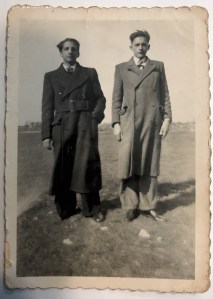
My father, left, as a 17 year old

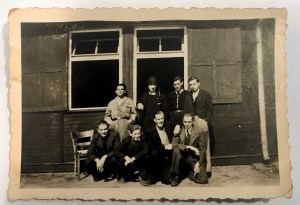
The process however, especially with the old photos is an emotional one – my dad as a 17 year old rugged up in a heavy coat. What were you thinking dad at the time this photo was taken? Where did you expect your life to lead? There are the photos of his time as an indentured worker in Germany. I see camaraderie and youth but not too many smiles. The Christmas Tree in 1943 is particularly evocative. And then there is the eerie doubly exposed photo of a young woman superimposed on what seems like a park. I have this faint memory that this was a girlfriend before my mother came on the scene. Why was this photo kept? I know my mother wanted it to be thrown out.

The mysterious double exposure

There are photos of Rotterdam before it was bombed by the Germans and then the Allies with the Kestein bicycle factory (thank you Google) with a loaded wagon pulled by draught horses. Another time and place. A world away from 2020. There are bicycling holidays after the war. What were your hopes then, dad, when so much had happened and when a blanket of pain and suffering had settled over Europe.

The sorting is a slow process as you can’t help but look at the photos and ponder as you try to sift behind the black, white and grey images and the softly fading faces.

My father, back left, in Hennigsdorf, Germany
Rotterdam before the war
Categories: Family, my dad, Photo | Tags: , , | 3 Comments

A Pandemic Rant

My wife told me to write the following to get it out of my system.


I have become increasingly perturbed by the “sooking”, all the complaining and whinging coming out of society since the lock downs that been imposed. “Why can’t we do this now.(Clubbing, shopping, visiting)”  “I am depressed because I’ve got my kids at home.” I can’t do this and that and the list of complaints goes on  …

I am not denying that the coronavirus is a huge upheaval and people have lost their jobs, and life has been hugely disrupted – and people are dying. It is huge and it going to continue being an issue for quite some time. However, in the whole sweep of history it is not the Black Death with a third of the population wiped out, it is not a reign of terror by invading hoards, it is not the nightly fear of bombs dropping on our heads and living in the Underground every evening, it is not a nuclear holocaust. It is a pandemic, the likes of which we haven’t seen in many generations. Yet in most western countries, with a few stark exceptions, and certainly in Australia the impacts have been managed.

The virus has, however, revealed a deep lack of individual and community resilience. I believe we need to place ourselves in the context of history rather than in our self-centred C21st  bubble. My father was born at the end of WW1. The Spanish flu was running riot. When he was 10 the Great Depression started and by the time he was 20 he was picked up by invading Germans and forced to work near Berlin through the best part of his early 20s. At thirty-three he picked up his young family and migrated to Australia, worked hard, never made much money but also never complained. The thing is, he wasn’t unique. It was a characteristic of his generation. There was a resilience and tenacity. When I complained about the jobs I was supposed to do as a young boy there was, understandably, very little sympathy. He didn’t know the phrase “suck it up” but that was the intent.

The question I want to pose is, why do so many today, young and old, show a lack of resilience? With all the comforts, technology and government safety nets of our society, where is the sense of fortitude, courage and desire to overcome?

Is it that in the last few generations we have protected ourselves and children from tough choices, hard decisions and even the more mundane daily tasks that simply mean putting aside our discomfort and stepping up? If our children are told to hang the washing, weed the garden, clean the bathroom or wash the car is the expectation that they do it whether they like it or not. “Suck it up.”

What have we learned about ourselves over the past months? Are there attitudes we need to change? Are there areas of our life where we need to grow a backbone? This pandemic will be wasted if is all about returning to life as normal because it may just be that “normal” was not such a healthy state after all, for us, our families and society.

And finally, it is not simply about finding the “positives”. For many, particularly those who have lost loved ones, jobs and security, the message of “finding the positives” can be quite despairing because there aren’t any. The message, in fact, is far simpler. Life throws up many tough challenges and we need to have the courage to struggle against them whether they are individual, family or communal. It is a trait that should be learned from childhood. It is a resilience that enables communities to fight wars against evil oppressors, individuals to persevere over personal struggles and societies to fight pandemics. Is it that lesson we are all being reminded of? Looking around and observing social behavior I find the answer to that question quite disheartening.

Categories: community, Family, Uncategorized | Tags: , , | 4 Comments

Blog at WordPress.com.