Uncategorized

My Friend Johan

When I was regularly writing for a church newsletter I had a “friend” whom I used to illustrate points – usually negative ones. “Johan vander Bakslijder” was my fictional creation who was involved in things that one hoped that the congregation wasn’t – even though I knew that some were. It was a way of raising issues without accusing people directly and without making the climate too uncomfortable.

But if the truth be known, often Johan’s struggles mirrored mine. In fact there is a bit of Johan or his wife Johanna in each one of us.

We Christians are a fragile lot. I am fragile. How often I am disappointed with a sharp undisciplined word that comes from my mouth, or a sudden rise in temperature when  my toes are trodden on … or an improper thought inveigles itself  into my mind. Daily through my foolishness I am reminded that God’s grace needs to be my constant companion. He needs to look at me through His “Christ coloured glasses” or else I would be in deep trouble.

But not only do I need that grace but also the people around me – people whom too often I am tempted to judge. People who have not encountered Jesus. People who also need to know that their brokenness can be forgiven and dealt with. Who is going to tell them or show them unless it is “Johan” or “Johanna” who can attest to the joy of having been forgiven and who continue to be forgiven daily despite their failings.


Categories: christian, Christianity, Faith, Uncategorized | Tags: , , , | Leave a comment

The Wesleys’ Hymns

This past weekend my wife and I attended a Wesley Hymn Fest, where, as you can imagine, we were led in the enthusiastic singing of Wesleyan hymns.  Now I don’t come from the Methodist tradition but there was something very special about 250 people being led by a small group of musicians, pipe organ and choir, declaring in song  messages of hope, faith and truth.

I was struck by the wonderful words of the hymns.  Charles Wesley, often assisted or supported by brother John, knew his Scripture and wove this understanding into his verses.  Many hymns were inspired by particular Bible passages, or were Bible passages put to music. In response to Isaiah 51:9 he penned:

Arm of the Lord, awake, awake!
Thine own immortal strength put on!
With terror clothed, hell’s kingdom shake,
And cast thy foes with fury down!

The hymns also reveal a great understanding of the human condition. In an era when many children died young one can feel the tension of faith and pain that Wesley was only too familiar with in a hymn we didn’t sing last Sunday:

Dead, dead! the child I loved so well!
Transported to the world above!
I need no more my heart conceal;
I never dared indulge my love:
But may I not indulge my grief
And seek in tears a sad relief?

The language is quaint but the messages are still intimately personal:

My God, I am Thine, what a comfort divine,
What a blessing to know that my Jesus is mine!
In the heavenly Lamb thrice happy I am,
And my heart it doth dance at the sound of His name.

The image of the dancing heart is uplifting! Charles Wesley wrote nearly 6000 hymns which were often composed for special occasions. And still there were many others from the era who wrote fabulous hymns from John Newton’s Amazing Grace to Isaac Watts’  When I Survey the Wondrous Cross. Watts was a comparative sluggard as he only wrote 750 hymns. And there are others: William Cowper, Frances Havergal … and all the way back to Bernard of Clairvaux  to name only three.

In many churches today these hymns have disappeared under the weight of modern songs and choruses.  Every era is inspired by the Spirit anew but we shouldn’t forget these incredible songs from the history of the church – a history that extends all the way to the early church. In the case of the Wesleys it was a history of renewal and revival. It would be good if we had links to these brothers and sisters from the past every time we met in worship.

Here is one of my favourite singers singing one of Charles Wesley’s songs.  Maddy Prior and the Carnival Band also have a great album of Wesley’s songs called Paradise Found:

Categories: christian, Christianity, Church, hymns, Uncategorized | Tags: , , , | 11 Comments

Greater Love

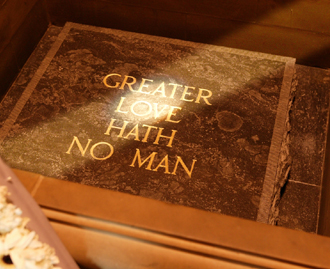
Photographic record of the Shrine of Remembrance, photographer unknownLast night my Literature students and I went to a performance of Shakespeare’s cross dressing comedy, ‘As You Like It’.  It explores love in many of its facets. How and why does it happen?  What does it do to us – for good or bad?  Is it different for men and women?  What external influences are involved? What about our motives? … and there are more uncomfortable questions.

But underlying all of that is the idea that love, romantic and otherwise, is an essential part of the human character. We all want to love and be loved. A life without love is empty and possibly meaningless.

And then this morning at our College’s  ANZAC  service our Senior School Captains spoke on the verse John 15:13  “Greater love has no one than this: to lay down one’s life for one’s friends.”  This is paraphrased in the War Memorial in Melbourne – “Greater love hath no man”.

This verse must be seen in the context of Christ reflecting on his own sacrifice and then suggesting to his disciples that this sacrifice in turn become a model for their lives. Accepting Christ’s love becomes the foundation of our desire to love like he does. Love, here, is a giving of one’s self for others. It puts others first, which is no doubt the reason for its presence in the War Memorial it highlights the Aussie ideal of mateship.

There is nothing amiss with the Bard’s exploration of love. He raises excellent questions and challenges us. However, the answers are not found in his plays, but rather in the gospel. Christ’s love becomes a model for our relations – romantic and otherwise.  Christ’s love doesn’t start with our own private swooning’s, or sexual desires but for the welfare and best outcomes for the other – friend and foe alike.

Shakespeare raises tough questions but Jesus gives us even tougher answers.

Categories: christian, Christianity, community, Uncategorized | Tags: , , | Leave a comment

Two Dreams

Our dream life is a mysterious and unfathomable part of the mind.  My wife had two successive dreams that caused me to wonder. I usually find this area of life too ethereal to write about but here are the two dreams as my wife relates them.
Last night I had two dreams. Like Pharaoh, I woke up wondering what they could mean. Where is Joseph when you need him?In the first dream I was at a book fair run by a church and a Bible college. There were many tables laden with theological books. There were also women putting lots of delicious looking baked goods onto other tables. Little children raced around amongst the tables and everything looked ready for business. But there were no customers. One woman expressed her dismay. “We made all this food to encourage people to come.” “But there’s no place for people to sit” I said, “and you’re not offering any coffee or tea.”

In the second dream I was again at a fair. This time it was a toymaker’s. I had heard about it and Pieter agreed to take me there. He dropped me at the door and we arranged a time for him to return. As I stepped into the building, which happened to be an old wooden church, the toymaker himself greeted me. But my attention was completely taken by the sight before my eyes. Handmade toys of every description: felted dolls in gaudy colours, brightly painted wooden vehicles and puppets, metal wind-up toys sparkled on the shelves, and a hundred pretty mobiles hung from the ceiling. “Oh, this is amazing!” I enthused.

Immediately, the toymaker reached up and took down one of the mobiles. It was a nice one, but others had already caught my eye. As I continued to enjoy the fantastic array of toys, the toymaker took the mobile to the counter and began to wrap it. I believed he had made a wrong assumption and I was quick to point this out to him. “No, no,” I said, “I don’t want that!” He didn’t stop straight away, and I had to repeat myself several times. Finally he ceased wrapping. His hands fell at his sides and he looked up at me. There were tears in his eyes and his whole face crumpled with grief. Slowly he turned and walked away.

Some women were also in the shop and they’d seen what happened. One came to me and quietly explained. “The toymaker made every toy in this place,” she said.
“But didn’t he understand that I didn’t want to buy that toy?” I interjected. “I would have bought something else; it’s all beautiful, I would have found something to buy.”
“Buy?” she said. “He was going to give it to you!”

You can imagine my horror to hear this. I needed to find the toymaker and explain my actions. But then Pieter returned and still the toymaker hadn’t reappeared. I had no choice. I left the toy fair empty-handed.

Somehow I think these stories should be prefaced with the words of Jesus – “The Kingdom of Heaven is like…….”

Categories: Uncategorized | Tags: , | Leave a comment

Jesus Unicorn

Today my wife, Hetty, is presenting a guest blog on the topic of children and worship.

Jesus Unicorn

Courtesy Google  images

Courtesy Google images

A young girl was given a notebook and some colouring pencils and pens while she sat in the pew with her family.  After a few weeks, her parents suggested that she listen to the sermon while she drew. By the end of the sermon she had drawn some pictures of a unicorn with the words ‘Jesus Unicorn’ above them.  Her parents were amused.
 
Some questions:
 
  • What did her parents believe children should be doing in a worship service?
  • Did they give her any guidance about what she could do with the writing and drawing materials?
  • What was the underlying message the child got concerning how she should behave in the worship service and from her parents’ subsequent suggestion?
 
Some ideas:
 
If you were her parents, how might you encourage her to participate in the worship service?
How would you begin a discussion with this child about ‘Jesus Unicorn’ which could lead her to a fuller experience of worship?
 
Paper and pencils are fine to keep a child’s hands busy, to keep a child quiet, and even as a stepping stone to taking notes of the sermon but it should never stop there.
Children can draw the stories they hear (and they should be hearing God’s stories, not just theological concepts) or their feelings. There should be a clear understanding of when they can draw/write and when they should be participating in the singing, praying, etc.  Parents should follow up with the child later. It may help if the parents also occasionally used paper and pencils during the sermon, and the family shared their pictures afterwards.
 
A warning:
 
Be careful not to let this become another kind of ‘school’ activity.
Help the child to use the writing and drawing, as well as the words they’re hearing and the images they’re seeing, as a way to explore their understanding of God, and the worship of Him.
 
 
Hetty Stok
Categories: Child Theology, Children, christian, christian education, Christianity, Church, Uncategorized | Tags: , , , | 8 Comments

Confused World

I have been watching with concern and bemusement the attempts of our government to halt the execution of two Australians in Indonesia.  My hope and prayer is that they succeed even though this seems very unlikely.  However, this situation highlights the inconsistency of our society.  While huge efforts are being put into saving these two, thousands of unborn children are murdered every year without the legal challenges and TV and newspaper headlines.  The moral outrage at killing two Australians doesn’t match our government’s efforts with asylum seekers in detention.

The 6th Commandment, “Thou shalt not kill” is a declaration of the importance and value of life. It reminds us that humanity was created in God’s image.  In the words of John Donne, “Any man’s death diminishes me.” Human life is precious but governments and corporations have devalued them to “economic units”.  Movie producers and and game designers have made death a form of entertainment.  Even religions murder others to advance and justify their beliefs. Worse still, we have come to believe many of the corrupted messages that swirl around us today. In my naive and simple way I believe it is time to reclaim two truths: 1. Humanity was made in the image of God (a huge discussion just by itself!) and because of that, 2. Human life is precious. If we believed that passionately it would change the tenor of our discussions and behaviours.  Our view of others would begin to change and our view of ourselves would change.

As a Christian I understand that only the Holy Spirit changes hearts but we have a challenge and responsibility to remind ourselves and the world what a gift life is.

Categories: christian, Christianity, Church, community, Life, Uncategorized | Tags: , , | 9 Comments

Carols of Contrast

When I heard Christina Rossetti’s carol for the first time I became intrigued by the idea of how climate affects the carols written within a culture. I have contrasted this with an Australian carol by John Wheeler.  They also explain why barbecues are popular during Christmastime in Australia and not in the UK.

The North Wind is Tossing the Leaves

John Wheeler

12128928444_6799c7be56_z

Wombat State Forest

1.
The North Wind is tossing the leaves,
The red dust is over the town,
The sparrows are under the eaves,
And the grass in the paddock is brown;
As we lift up our voices and sing
To the Christ-Child the Heavenly King.
2.
The tree-ferns in green gullies sway;
The cool stream flows silently by;
The joy bells are greeting the day,
And the chimes are adrift in the sky,
As we lift up our voices and sing
To the Christ-Child the Heavenly King.


In the Bleak Midwinter

Christina Rossetti
1.

In the bleak midwinter, frosty wind made moan,

Dorchester near Henley on Thames

Dorchester near Henley on Thames

Earth stood hard as iron, water like a stone;
Snow had fallen, snow on snow, snow on snow,
In the bleak midwinter, long ago.
 2.
Our God, Heaven cannot hold Him, nor earth sustain;
Heaven and earth shall flee away when He comes to reign.
In the bleak midwinter a stable place sufficed
The Lord God Almighty, Jesus Christ.
 3.
Enough for Him, whom cherubim, worship night and day,
Breastful of milk, and a mangerful of hay;
Enough for Him, whom angels fall before,
The ox and ass and camel which adore.
 4.
Angels and archangels may have gathered there,
Cherubim and seraphim thronged the air;
But His mother only, in her maiden bliss,
Worshipped the beloved with a kiss.
 5.
What can I give Him, poor as I am?
If I were a shepherd, I would bring a lamb;
If I were a Wise Man, I would do my part;
Yet what I can I give Him: give my heart.


Categories: Uncategorized | Leave a comment

Advent Poems

The following poem by T.S. Eliot is thought to be a reflection on his own journey towards faith.

The Journey Of The Magi

‘A cold coming we had of it,
Just the worst time of the year
For a journey, and such a long journey:
The ways deep and the weather sharp,
The very dead of winter.’
And the camels galled, sorefooted, refractory,DSC_0003crop
Lying down in the melting snow.
There were times we regretted
The summer palaces on slopes, the terraces,
And the silken girls bringing sherbet.
Then the camel men cursing and grumbling
and running away, and wanting their liquor and women,
And the night-fires going out, and the lack of shelters,
And the cities hostile and the towns unfriendly
And the villages dirty and charging high prices:
A hard time we had of it.
At the end we preferred to travel all night,
Sleeping in snatches,
With the voices singing in our ears, saying
That this was all folly.Then at dawn we came down to a temperate valley,
Wet, below the snow line, smelling of vegetation;
With a running stream and a water-mill beating the darkness,
And three trees on the low sky,
And an old white horse galloped away in the meadow.
Then we came to a tavern with vine-leaves over the lintel,
Six hands at an open door dicing for pieces of silver,
And feet kiking the empty wine-skins.
But there was no information, and so we continued
And arriving at evening, not a moment too soon
Finding the place; it was (you might say) satisfactory.

All this was a long time ago, I remember,
And I would do it again, but set down
This set down
This: were we led all that way for
Birth or Death? There was a Birth, certainly
We had evidence and no doubt. I had seen birth and death,
But had thought they were different; this Birth was
Hard and bitter agony for us, like Death, our death.
We returned to our places, these Kingdoms,
But no longer at ease here, in the old dispensation,
With an alien people clutching their gods.
I should be glad of another death.

T.S. Eliot

(The Lion Christian Poetry Collection)

Categories: Uncategorized | Leave a comment

Advent Poems

The following poem, written in 1915, is by Thomas Hardy.  The background includes a belief by some of the country folk of the day that on the stroke of midnight of Christmas Day the animals in the barns would kneel for the baby Jesus.  Being written during the Great War it could be seen, in part as longing for the past. The last line could also be seen as a plaintive cry for a lost faith.

The Oxen

Christmas Eve, and twelve of the clock.Mr Spears Allansford
“Now they are all on their knees,”
An elder said as we sat in a flock
By the embers in hearthside ease.

We pictured the meek mild creatures where
They dwelt in their strawy pen,
Nor did it occur to one of us there
To doubt they were kneeling then.

So fair a fancy few would weave
In these years! Yet, I feel,
If someone said on Christmas Eve,
“Come; see the oxen kneel

“In the lonely barton by yonder coomb
Our childhood used to know,”
I should go with him in the gloom,
Hoping it might be so.

Categories: Uncategorized | Leave a comment

Advent Poems

In this Advent poem the Australian poet, Henry Lawson, connects the first and second Advents and links it with the need for social justice.   You may not necessarily agree with his theology.

In the StreetMary

Where the needle-woman toils
Through the night with hand and brain,
Till the sickly daylight shudders like a spectre at the pain –
Till her eyes seem to crawl,
And her brain seems to creep –

And her limbs are all a-tremble for the want of rest and sleep!
It is there the fire-brand blazes in my blood; and it is there
That I see the crimson banner of the Children of Despair!
That I feel the soul and music in a rebel’s battle song,
And the greatest love for justice and the hottest hate for wrong!

When the foremost in his greed
Presses heavy on the last –
In the brutal spirit rising from the grave-yard of the past –
Where the poor are trodden down
And the rich are deaf and blind!

It is there I feel the greatest love and pity for mankind:
There – where heart to heart is saying, though the tongue and lip be still:
We’ve been through it all and know it! brother, we’ve been through the mill!
There the spirits of my brothers rise the higher for defeat,
And the drums of revolution roll for ever in the street!

Christ is coming once again,
And his day is drawing near;
He is leading on the thousands of the army of the rear!
We shall know the second advent
By the lower skies aflame

With the signals of his coming, for he comes not as he came –
Not humble, meek, and lowly, as he came in days of old,
But with hatred, retribution for the worshippers of gold!
And the roll of battle music and the steady tramp of feet
Sound for ever in the thunder and the rattle of the street!

Henry Lawson 1894
(Source: http://www.ironbarkresources.com/henrylawson/InTheStreet.html
Categories: Advent, Poem, Uncategorized | Tags: , | Leave a comment

Blog at WordPress.com.