Uncategorized

Nostalgia Isn’t What It Used To Be

Opa and the bakery cart

I know I have stolen the title above but it caused me to reflect on my father. For a while my dad was an itinerant hawker selling fruit and vegetables from home to home,  around Ocean Grove and Geelong. There was a tradition in my family of this type of work. A grandfather and a great grandfather had done the same. In fact it was an age of home delivery. The baker, butcher, iceman, milkman and even the draper came in vans on a regular basis. I remember the Rawleigh man coming with his suitcase of lotions and potions. The memories of hearing the milkman’s horse clip clopping past the house in the early morning and chasing the iceman for a piece of ice on a hot dusty day in summer, is still strong.

Slowly these mobile salesmen (I don’t remember ever seeing a woman do this) have faded into the past. Supermarkets and cars led to their demise.  Nothing ever stays the same. Today we are seeing a modern version: Internet sales. The sales people are in our homes and what we want is delivered to our doors. I have to confess that a lot of my purchases are now delivered by my “Pay” pal.

Yet I still miss riding in the back of my dad’s truck during the holidays “helping” him on his rounds and meeting his amazing variety of customers; migrants from all parts of Europe, a WW1 gas attack survivor, and a seaman who had clung to a table when the Titanic sank.  My dad being a gregarious man elicited amazing stories from these, now long gone, people. And I miss the smell of fresh bread wafting from the back of the baker’s van. Horses and carts on the street, even a few, seemed to have a way of slowing life down to a more reasonable pace.

The internet is helpful and efficient. Its range is enormous. But give me the hawkers and the colour and life they brought from house to house. I can’t imagine my children ever being nostalgic about a mouse click on an internet sales site.

Categories: Family, History, Reflections, Uncategorized | Tags: , | 3 Comments

Holy Sonnet 14: Batter My Heart

Batter my heart, three person’d God; for, you
As yet but knocke, breathe, shine, and seeke to mend;
That I may rise, and stand, o’erthrow mee,’and bend
Your force, to breake, blow, burn and make me new.
I, like an usurpt towne, to’another due,
Labour to’admit you, but Oh, to no end,
Reason your viceroy in mee, mee should defend,
But is captiv’d, and proves weake or untrue.
Yet dearley’I love you,’and would be loved faine,
But am betroth’d unto your enemie:
Divorce mee,’untie, or breake that knot againe,
Take mee to you, imprison mee, for I
Except you’enthrall mee, never shall be free,
Nor ever chast, except you ravish mee.

John Donne 1572 – 1631

A statue of Donne dressed in his funeral shroud in St Paul’s London. Courtesy: Google Images

Once again I would like to return to this poem by John Donne. In this most honest of poems he reminds us of the struggle to be sanctified – made holy. In terms of a medieval blacksmith beating his iron, or city under attack he calls on God to take him captive because otherwise he would be the “enemie’s” captive. In an almost shocking and ironic line he asks God to “ravish” him to make him “chast”.

Time and again when I read this poem I am struck by Donne’s use of human love as a metaphor for God’s love. Even his relationship with Satan is described in terms of betrothal. But is it really that strange? The relationship between man and wife, at its best, is a wonderful image of love. Christ, himself, speaks in terms of a bride and bridegroom when he refers to himself and the church.

Donne’s poem is also a reminder in the current debate about marriage that Christians are called to demonstrate with their lives and voices what a Biblical view of marriage is. It is the greatest weapon we have in promoting marriage as God intended. After all, Jesus uses it to give us an insight into our relationship with him. This is something John Donne understood.

Categories: christian, Christianity, Devotional, Faith, Poem, poetry, Uncategorized | Tags: , , , , | 2 Comments

What Can You Take To the Grave?

What can you take to the grave? Anything you like, it seems. I asked a friend who has worked in the funeral industry if people take their mobile phones with them when they are buried? I was thinking of the discredited rumour that Mary Baker Eddy had a phone installed in her mausoleum. The truth, it seems, is far stranger.

Extra clothes, food, gardening tools, X rated films and a whole host of other paraphernalia are placed in coffins. Some more elaborate coffins and caskets have photos and paintings on the inside of the lid. One wonders why? These arrangements make even the Pharoahs’ preparations seem quite reasonable.

It is apparent that many people have some vague concept of an afterlife. But what sort of afterlife is it if you need to take these things with you? Is it just another version of planet earth as we know it? If it is, why bother?

Scripture gives us a far more glorious picture than hare-brained human fantasies. The resurrection of the dead is most clearly witnessed in the life of Christ. He is our chief evidence for its truth. However there are other passages too. 1 Corinthians 15 and 1 Thessalonians 4 are just two that remind us that there will be a resurrection. The dead will rise. However it is fascinating that we are given no instructions as to how people should be buried.

I believe the Bible consistently points to both the mystical and miraculous. The resurrection is not about a rebirth into a broken human condition, but an overcoming of all that was sinful and broken. Christ will take us into the presence of God for eternity. Scripture gives us many tantalising but incomplete glimpses which point to a certain hope. What we see, though, is exciting and amazing. It also strongly suggests that we can leave the mobile phone, gardening tools and videos behind. What we are called to do to make this resurrection a glorious reality is to trust completely in the one who showed the way – Jesus!

Categories: christian, Christianity, Devotional, Faith, Uncategorized | Tags: , , , | Leave a comment

We Did Not Follow Cleverly Invented Stories

“For we did not follow cleverly devised stories when we told you about the coming of our Lord Jesus Christ in power, but we were eyewitnesses of his majesty. 2 Peter 1:16

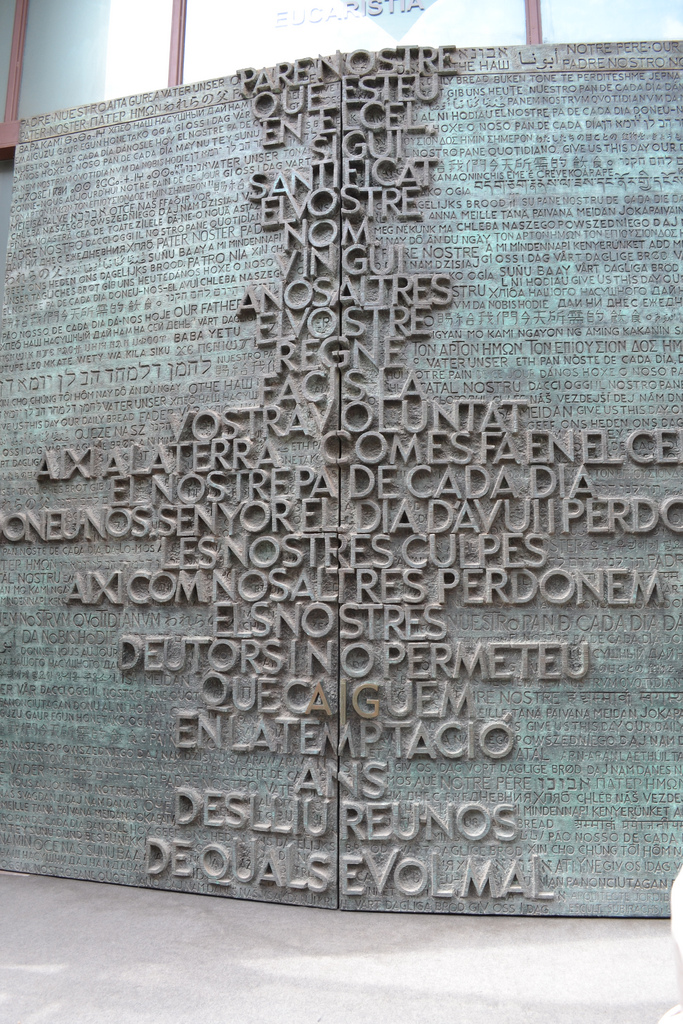
Lord’s Prayer at the Sagrada Familia

When Peter starts his second letter which is aimed at false teachers, he clearly makes Christ the anchor of his authority. Peter speaks from the foundation of knowing Christ and and the Old Testament. This is his measuring stick for truth and sound knowledge.

It amazes me how often Christians are distracted and misled by “invented stories”. In the last generation we have had the “prosperity gospel”, gold dust descending on believers, the virgin Mary appearing in toast, trees and a whole host of other places, as well as many many more unsound and unhealthy ideas.

But there are more subtle “invented stories”, such as, the middle class materialistic lifestyle is a Christian life style, right wing politics is Christian politics, it is ok to pilage the environment and, once again, there are many many more perversions. We have been conned by celebrities, populist preachers and glib advertisers, as well as our own desires.

Peter’s solution is still the best: Measure all thing we hear and see against Christ and Scripture. The question is, “what is God’s intention?” and not “what is my desire”? Our desires will, time and again, lead us astray.

I don’t want to get ahead of myself, but chapter 2 alerts us to the destruction that false and misleading teaching produces. Our aim, in contrast, is to seek God’s will and promote His purposes. In our “Me Centred” generation the calling of the Christian and the Church is to point to Christ. That simple focus will prevent most of the “cleverly invented stories” arising.

Categories: Bible, christian, Christianity, Faith, Second Peter, Uncategorized | Tags: , , , | 2 Comments

What the Future Holds

A few days ago when I was writing about the joy of family life I included a photo of my grandparents, my mother, an aunt and two uncles, taken in the late 1920s. Later as I reflected on that picture I thought to myself that my grandparents had no idea of what lay before them at this time.

Soon after this photo was taken the world would be gripped by the Great Depression (The Global Financial Crisis on steroids) and then would come the second Great War. They had lived through the first as children. Two of the children in this photo would emigrate:  one to Australia, and later, one to Canada. The daughter (my mum) travelling to Australia would take the only grandchild (me) they would ever see.

One of the uncles in the photo would die of starvation in a home for people with special needs during the later years of WW2. This period was known as the “hunger winter”. My grandfather was incapacitated by heart problems and both grandparents would be dead before 60 years of age.

They did not know what the future would bring. One of my uncles, who was born just after this photo was taken,  often reminds me that it was a tough time. But for all the seeming bleakness of this story there is a bright shaft of hope. These amazing people left a legacy of faith in their family. Despite the hardships there was a trust in God and His promises for His people and His Kingdom. They were faithful in bringing their children up in the knowledge of God and were members of a church.

Even though they had no idea of what the future would bring, they prepared their family as best they could, for it. All the people in this photo are now dead. Earlier this year my mum was the last to pass on. But I am convinced that they live on in the presence of God right now and their faith lives on in many of their children and children’s children.

We do not know the future either, but like my grandparents we do have the opportunity to sow seeds of hope and eternity.

But from everlasting to everlasting
the Lord’s love is with those who fear him,
and his righteousness with their children’s children —
with those who keep his covenant 
and remember to obey his precepts. Psalm 103: 17 & 18

Categories: christian, Christianity, Faith, Family, Future, Uncategorized | Tags: , , , , | 6 Comments

The Beauty of Words

A wonderful little book has come into my possession. It is a facsimile of the 1933 “Picturesque Word Origins” originally published by the by the same people who publish the Webster’s Dictionary. (This edition is by the Folio Society). With a number of delightful illustrations it traces the origins of a selection of words. Following are just a few:

“Congregation” is derived from the latin – “grex” meaning flock and translates as “to gather the flock”. This, of course, combines beautifully with the image of pastor or “pastum”, a shepherd.

“Enthusiasm” comes from the Greek “en” in and “theos” god – in other words, having god within. Now, shouldn’t all Christians be enthusiastic!

“Neighbour” takes us to an agricultural time. It comes from the Anglo-Saxon “neah” or “nigh” meaning near and “gebur” meaning farmer. Your neighbour was the “near – farmer”. In modern life this has turned into the person next door.

A “Pedagogue” was a trusted slave in Greece who escorted or led “agogos” the master’s sons “pais”. They were “boy guiders”. This was borrowed by Latin an turned into “pedagogus”.

“Volume” comes from the days when sheets of papyrus were glued into a roll, “volumen” in Latin, and the document was rolled, from “volvere”, from one staff to the other.

Psalm originates from plucking a stringed instrument; Rapture from abduction by force, and chapel finds its origins in a cloak or hood. I could go on but I wont. It is a such a wonderful book. For me it was an apt reminder that words carry meaning and to explore these can be richly rewarding.

Categories: christian, Christianity, Ecc, Uncategorized | 3 Comments

Pushing Through Curtains

Pushing back through curtains
upon curtains
billowing in a foggy past
there have been
people whose sepia faces
bring back faint memories
of times and places
now hovering
between reality
and imagination.
There were
school yard boasts
and pranks
too energetic now
for the memory to understand
Friends gone
in distance and death.
Vocations
have come and gone
and come again.
My first students
now have faces
as worn as mine
but their fresh faces
live in their children.
Years hold blessings and pain
hopes and failures
joy and aches.
But when I turn
And stop pushing
At the curtains
There is a future
a timelessness
… and a perfection.
Categories: christian, Devotional, Faith, Poem, poetry, Uncategorized | Tags: , , , , , | Leave a comment

The 5th Gospel

Friends and colleagues connected with Covenant College in Geelong are currently working on a project called “The 5th Gospel”.

A group of 4 went to Israel earlier this year to film and do research. Initially the intent was that this material could be used in the History and Bible courses at the College. However it is becoming obvious that this effort could have far wider uses in other schools, churches and homes. To this end the project is being introduced to the community on the 4th of August. If you are in the vicinity you are very welcome to come along and hear about this exciting venture.

Categories: christian, Christianity, Education, Uncategorized | Tags: , , | Leave a comment

Promise and Deliverance

Image: Courtesy Amazon

Yesterday I quoted from the dutch classic by Abraham Kuyper, The Work of the Holy Spirit. There is another work that many English speaking readers may not be aware of: Promise and Deliverance by S.G. De Graaf. This was written in the first half of the C20th as teaching tool to assist in the teaching of young people and translated into English a number of years ago. This 4 volume set is in fact a brilliant excursion through the Old and New Testament looking at the centrality of Christ throughout Scripture; the promise of Christ in the Old Testament and the Deliverance of the promise in the New. Christian school teachers, parents and Sunday School teachers will find this a useful tool to stay out of the trap of moralising Biblical stories but rather remaining centred on the “main story”.

These books are available as PDFs at  Paideia Books along with many other wonderful books – many from the dutch Calvinist tradition.

Below is a quote from the first chapter on Gen1-2:

1: The Kingdom of God
Genesis 1-2:3
In this first section of Genesis we are not just told that God created
all things. What is revealed to us first and foremost is the Kingdom of
God. At this point we cannot speak of this Kingdom as the Kingdom of
God’s grace, for by grace we usually mean the favor to which we have
lost all claim, i.e. the favor of the forgiveness of our sins. To avoid confusion,
therefore, we should speak here of the Kingdom of God’s favor.*

The institution of the Kingdom of God is central to this chapter. In
preparing the earth in six days, God repeatedly brings forth the higher
from the lower and makes the lower subservient to the higher. Finally He
creates man and makes him king (Gen. 1:26-8). With the creation of
earth’s intended king, God reaches the culmination of His work. We
hear something of His rejoicing when He says: “Let us make man in our
image, after our likeness; and let them have dominion.” These words
give us the impression that God is saying: “Now let Us make man. Now
We are reaching the climax of Our work.”

Categories: christian, Christianity, Devotional, Faith, Uncategorized | Tags: , , , , , | Leave a comment

The Work of the Holy Spirit – Abraham Kuyper

The Dutch Minister/Statesman, Abraham Kuyper wrote a wonderful series of devotionals on the Holy Spirit entitled The Work of the Holy Spirit which initially appeared in a weekly Christian publication. It is a detailed and thorough explanation of the development of the work of the Spirit through the Old and New Testaments. Over a hundred years later this is still a wonderful and inspiring work. It is available online at CCEL.org.

The first quote is from chapter 1 and the following quote comes from chapter 37:

“The need of divine guidance is never more deeply felt than when one undertakes to give instruction in the work of the Holy Spirit—so unspeakably tender is the subject, touching the inmost secrets of God and the soul’s deepest mysteries.

We shield instinctively the intimacies of kindred and friends from intrusive observation, and nothing hurts the sensitive heart more than the rude exposure of that which should not be unveiled, being beautiful only in the retirement of the home circle. Greater delicacy befits our approach to the holy mystery of our soul’s intimacy with the living God. Indeed, we can scarcely find words to express it, for it touches a domain far below the social life where language is formed and usage determines the meaning of words.

Glimpses of this life have been revealed, but the greater part has been withheld. It is like the life of Him who did not cry, nor lift up nor cause His voice to be heard in the street. And that which was heard was whispered rather than spoken—a soul-breath, soft but voiceless, or rather a radiating of the soul’s own blessed warmth. Sometimes the stillness has been broken by a cry or a raptured shout; but there has been mainly a silent working, a ministering of stern rebuke or of sweet comfort by that wonderful Being in the Holy Trinity whom with stammering tongue we adore as the Holy Spirit.

….

“The Church has a calling in the world. It is being violently attacked not only by the powers of this world, but much more by the invisible powers of Satan. No rest is allowed. Denying that Christ has conquered, Satan believes that the time left him may yet bring him victories. Hence his restless rage and fury, his incessant attacks upon the ordinances of the Church, his constant endeavor to divide and corrupt it, and his ever-repeated denial of the authority and kingship of Jesus in His Church. Altho he will never succeed entirely, he does succeed to some extent. The history of the Church in every country shows it; it proves that a satisfactory condition of the Church is highly exceptional and of short duration, and that for eight out of ten centuries its state is sad and deplorable, cause for shame and grief on the part of God’s people.

And yet in all this warfare it has a calling to fulfill, an appointed task to accomplish. It may sometimes consist in being sifted like wheat, as in Job’s case, to show that by virtue of Christ’s prayer faith cannot be destroyed in its bosom. But whatever the form of the task, the Church always needs spiritual power to perform it; a power not in itself, but which the King must supply.

Categories: christian, Christianity, Devotional, Faith, Uncategorized | Tags: , , , , , | Leave a comment

Blog at WordPress.com.