Posts Tagged With: Church

Burying Our Children

The following is a challenging and uncomfortable reflection from my wife.


Burying our children?
What if the talents of Matthew 25 were the children in our churches? What if the servants were the adults, and the elders?

How would the parable look in your church? How would it end?
How many children has your congregation been given?

Does it matter how large or small the original number is? Did the master give the greatest number of talents to the best businessman?
Some churches have very few children or even none at all. Did they bury them a long time ago?

Some churches have children who might as well be buried. There is no sign of them in the liturgy or the worship place. There are no signs that they may occasionally be present, no expectation that some children might appear one day. (That reminds me of a church service we attended with our kids while on holidays. Ours were the only kids in the church and the preacher could not have known that we would be coming, but he had a children’s talk ready.) 
Our services are designed for those aged 20 to 60 years old, of average intelligence, good at listening, reading and singing. (As opposed to being good at looking, watching, drawing, wriggling, dancing, jumping or running.)


We conveniently don’t see the rest. We have buried them.
The Master gave children to churches. He expects to get a return on his investment. What does that return look like? 

What will it take to make the investment grow?

How exciting it will be when the Master returns to find his talents have grown a hundredfold!

Categories: Child Theology, Children, Church | Tags: , , | 1 Comment

Has Jesus left the Church?

I have deliberately made the title vague. It can be taken in a number of ways.

A few years ago I observed the lead up to Christmas and Christmas itself in Europe. In some places like Seville there was a Christmas market which only sold items for nativity sets. In another few markets I could have bought gloves, scarves and solar panels to do me for a few lifetimes. There has been a mixture of the sacred and secular. All in all, the secular wins.

But Christmas is only a microcosm of society’s attitude to faith and religion in general. So little of the Christ of Christmas remains but that is true of life in general.

So has Christ left the church, in the sense that even the church has left the Christ of Christmas tucked away in some small corner? We sing the carols, attend church for the one time in the year but they are empty tokens. How many sermons were preached this Christmas that declared a radical Christ who introduced a new kingdom through his own death and resurrection? How many sermons declared Christ’s own words, “I am the way the truth and the life. No one comes to the father except through me.” That politically incorrect statement comes from the Messiah and is unpopular in many churches today. The cute baby in in a feed trough is easier to speak about and certainly less confronting.

But there is an even scarier perspective. Christ withdrawing himself, not unlike the Shekinah leaving the temple in Ezekiel. Christ leaving because the people who bear his name do do so thoughtlessly. I know he says in Matt 28 that he will be with his disciples to the end of the age but that was on the basis of their continued faith (not perfection).

The radical Christ, the counter cultural Christ, the Christ of a new and everlasting kingdom, the Christ who purchased the lives of his people on the cross and is now preparing a place in eternity for them, the Christ who dwells in his people through the Holy Spirit, the Christ who fought injustice and prejudice, the Christ who tells us that this life is only a brief pilgrimage … He is so hard to find in many churches and many western lives. Alas, so often, in my own life.

Has Jesus left the church? Only if we, his representatives on earth, have left him. In our syncretistic and politically correct age we need need to have the courage of the one who gave us his name to stand up to the culture and attitudes of our age and reveal how amazing his message really is. This Christmas have we been overawed and amazed that God became one of us because He loved us so much? Have we been humbled by his claim on our lives? Are we rejoicing in the revelation of His kingdom?

A nativity scene in a side chapel at Caen Cathedral

Categories: christian, Christianity, Church, Faith | Tags: , , | 3 Comments

A Boy, a Camera and a Church

The following is an observation by my wife: 

 There he was, a boy of 5 or 6 years, standing alone in front of the altar. He danced a little, twisting this way and that, and then he stood perfectly still and raised the camera to his eyes and snapped. His parents quietly moved around the cathedral as the dozens of other visitors were doing. They must have been watching him, but they never interfered with his discoveries and his picture taking.
The cathedral was nothing but the usual Spanish Catholic variety; we had seen many like it. But it was new for this lad and whatever his eye saw was quickly recorded with his camera. The altar table, the decorative railings, the statues, the windows, the tourists.
I wondered and pondered on this for a while. 
A child discovering the church in his own way. 

A child finding the gospel in a language he knows and understands.

A child making memories and questions.

Parents letting go of their child enough to facilitate this.

A church full of images and symbols and furniture to capture a child.

A camera. Technology that a child can use.
How can we – parents, and faith communities – symbolically give our children a camera in the church?

What does it take to open their eyes and hearts to the Gospel?
  

Categories: Child Theology, Children, christian | Tags: , | 3 Comments

Is it Time for a New Reformation?

A number of books have been written in recent years that suggest that the direction the Christian Church has been going is profoundly warped and dysfunctional. Just take for example:

  • Radical by David Platt, which explores how we have shaped the gospel to suit ourselves and suggests, as the title implies, some uncomfortable remedies – image030uncomfortable for the materialistic, middle class, self-centred Western Christian.
  • Exiles by Michael Frost looks at how the church has been marginalised in Western cultures and offers new alternatives at being church.
  • There have been a host of books by Tim Chester and Steve Timmis looking at more effective ways of being the body of Christ.
  • Vishal Mangalwadi in The Book That made Your World shows how Western cultures influenced by the Bible have made huge strides but also reveals how we in the West have dropped the ball as we allow this heritage to dissipate.

You could probably add to the list. But my point is this: the sheer scale of people writing and thinking about the church at present indicates that all is not well in Western churches. If we add to this a host of other issues such as young people leaving the church, Christians leaving the church but maintaining the faith outside its influence and the ongoing influence of theologies that marginalise Scripture, we can get a sense of the enormity of the problem.  And we haven’t time to discuss all the areas of abuse the church has been involved in from paedophilia to scandals surrounding celebrity pastors, which have deeply wounded the voice of the church.

One of the stumbling blocks I see is that although some church leaders clearly recognise this problem their ability to act is limited. There are leaders in most churches who are alarmed by the figures both financial and human but in most cases they are seeking solutions from within the structure of their denomination.  The structure is the environment their thinking takes place in.  It is the structure, that for a whole host of reasons, from personal vested interests to tradition, that blinkers any genuinely radical Biblical vision. Property, jobs, “empires” and status are all involved in this unholy mix.  This is not dissimilar to the conditions in the Roman Church before the C16th Reformation.

And then there is us, we who in the West have succumbed to the attractions of materialism.  Our very view of life is shaped from the comfort of our easy chair.  We too are part of the problem.  Our thinking is shaped and anchored in our immediate self-interest. We too have vested self interests.

So, is it time for a new Reformation? I would genuinely love to hear the views of readers. And if it is, how will we hear God’s voice in the noise of our world?  How can our hearts be open to the leading of the Spirit? What steps can we take in faith?


Categories: christian, Christianity, Church, Reformation, Uncategorized | Tags: , , , , , | 7 Comments

Children’s Talks in Church

Here is another post by my wife whose passion is worship that involves all ages – especially children

Why is it that preachers look elsewhere when they speak with children about the things of God? Elsewhere than the Word of God? 

They spend a great deal of time conjuring “likes” out of their box of tricks. The church is like…. being a Christian is like…. forgiveness is like….

And there are a lots of objects in their magician’s kit as well. Namely objects for object lessons.  Unfortunately this sleight of hand only confuses the children who are before them.

Today we had a real magic trick performed for the kids. Three pieces of string of varying lengths were produced for the audience of a dozen preschoolers up to first graders. We heard about the tall people (longest string), the middle sized people (medium string), and … “babies” one child suggested for the shortest string, and we all laughed. More examples of varying things were suggested by the pastor, before he brought all six string ends together in one hand and said “watch this”. (I thought the correct word was abracadabra.)

Sure enough, he turned them into three pieces of equal length. Amazing!

Photo: Courtesy Domino the Jester

Photo: Courtesy Domino the Jester

Then he did another trick.

He turned the trick into an object lesson.

“We all look different, but Jesus has made us all the same.”

Maybe I think too deeply, or too literally about these things. I suspect some  children do too. Perhaps they’re thinking, “I don’t want Jesus to make me look like my brother. I don’t want my Mum and Dad or my baby sister to all be ‘middle sized'”. And that’s if they’ve managed to draw the connection between the strings and ‘us’.

Whichever way you choose to tackle this concept of Colossians 3:11, one thing’s for certain. Little children aged less than eight years old will probably not understand the abstractness of it.

This is when parents need to grow these concepts into their children as they walk along the road together, when they lie down and get up, when they eat and play together. This will be when the abstract becomes concrete for them.

And the pastors who are sitting with the church’s little ones at their feet?

Perhaps they should tell a story. A Bible story.

Categories: Child Theology, Children, christian, Church, Faith, Family | Tags: , , , , , | Leave a comment

What right do we have?

An email recently came across my desk from the Australian Christian Lobby urging me to contact Bill Shorten to express my disapproval of the proposed changes to the Marriage Act which will allow people of the same sex to marry.

20130422-204406.jpg

Two becoming one?

I will say clearly upfront, my belief is that marriage is an institution created by God, between a man and woman  (first modelled by Adam and Eve) for life. But I have a number of problems:

1. I live in a democratic country and it now seems that a large majority of my fellow citizens no longer believe that my faith held definition is correct.  So how far should or can I go in enforcing my understanding?  This is in contrast to promoting my understanding under the banner of free speech which I believe, as a Christian, I’m responsible to do with my life and words at all times.

2. My second question bites more deeply. If we who are evangelical/Bible believing Christians have such a high view of Biblical marriage, why have we allowed it to be devalued through our own behaviours within our own Christian community? Divorce rates in the church, even though a little lower than mainstream society, are still high. Cohabitation by church goers is also on the increase. My struggle is that we are calling others to standards that we ourselves are, increasingly, failing to hold.

3. Are there other solutions to this issue which meet the requirements of both the churches and society as whole?  In many European countries marriage is a social contract which is entered into at the town hall.  This contract gives you access to government benefits and a legally recognised status. Those who are Christian then go to a church to seek the church’s blessing. If we took an approach such as this it would separate church and state and leave the church free to bless those who believe in a Christian marriage, and it would also free it from being a “sub contractor” for marriages.

Has the time come for the Christian community to take seriously the need to make the Bible’s views attractive, not through legislation, but through the winsomeness of her own lifestyle? Like the early church, our faith driven lifestyle, should encourage our neighbours to want what God has bestowed on us.

Categories: Children, Church | Tags: , , | 15 Comments

The Wesleys’ Hymns

This past weekend my wife and I attended a Wesley Hymn Fest, where, as you can imagine, we were led in the enthusiastic singing of Wesleyan hymns.  Now I don’t come from the Methodist tradition but there was something very special about 250 people being led by a small group of musicians, pipe organ and choir, declaring in song  messages of hope, faith and truth.

I was struck by the wonderful words of the hymns.  Charles Wesley, often assisted or supported by brother John, knew his Scripture and wove this understanding into his verses.  Many hymns were inspired by particular Bible passages, or were Bible passages put to music. In response to Isaiah 51:9 he penned:

Arm of the Lord, awake, awake!
Thine own immortal strength put on!
With terror clothed, hell’s kingdom shake,
And cast thy foes with fury down!

The hymns also reveal a great understanding of the human condition. In an era when many children died young one can feel the tension of faith and pain that Wesley was only too familiar with in a hymn we didn’t sing last Sunday:

Dead, dead! the child I loved so well!
Transported to the world above!
I need no more my heart conceal;
I never dared indulge my love:
But may I not indulge my grief
And seek in tears a sad relief?

The language is quaint but the messages are still intimately personal:

My God, I am Thine, what a comfort divine,
What a blessing to know that my Jesus is mine!
In the heavenly Lamb thrice happy I am,
And my heart it doth dance at the sound of His name.

The image of the dancing heart is uplifting! Charles Wesley wrote nearly 6000 hymns which were often composed for special occasions. And still there were many others from the era who wrote fabulous hymns from John Newton’s Amazing Grace to Isaac Watts’  When I Survey the Wondrous Cross. Watts was a comparative sluggard as he only wrote 750 hymns. And there are others: William Cowper, Frances Havergal … and all the way back to Bernard of Clairvaux  to name only three.

In many churches today these hymns have disappeared under the weight of modern songs and choruses.  Every era is inspired by the Spirit anew but we shouldn’t forget these incredible songs from the history of the church – a history that extends all the way to the early church. In the case of the Wesleys it was a history of renewal and revival. It would be good if we had links to these brothers and sisters from the past every time we met in worship.

Here is one of my favourite singers singing one of Charles Wesley’s songs.  Maddy Prior and the Carnival Band also have a great album of Wesley’s songs called Paradise Found:

Categories: christian, Christianity, Church, hymns, Uncategorized | Tags: , , , | 11 Comments

Including Children in Church Community

There is a small but growing group of Christians who are eager to see the children of the church integrated into the life of the Church body and not just pandered to by programs. Although programs, in and of themselves can be quite useful, they can also stymie the discussions that churches and families need to have about faith formation in the life of their children. Programs by themselves often focus on knowledge (cognition) and what is missed is the beautiful mystery of faith and the excitement of disciple development.  I have written on previous occasions about the importance of the child’s vocation in the church. (Here is just one example).

Last night I heard David Csinos, who describes himself as an author, speaker, practical theologian, husband, researcher of children’s spirituality, and former children’s photo 4pastor, speak in Geelong. This was encouraging for a variety of reasons. It reminded me that there are more voices and often more articulate voices speaking out on this issue and it also caused me to reflect that this is not “rocket science” but requires families, churches and church leaders to engage in a prayerful discussion of how faith is developed in the most vulnerable and important members of our church communities.

If you wish to explore this important notion I have included some websites and books to explore:

  • David’s blog:   http://davecsinos.com/
  • The Journal of Family and Community Ministries (which is free to subscribe to): http://www.familyandcommunityministries.org/
  • A wonderful book is :  Children’s Ministry in the way of Jesus by Ivy Beckwith and David Csinos. This is a good place to begin your reflections if you haven’t started already, or to continue your journey.
  • Is it a Lost Cause: Having the Heart of God for the Church’s Children by Marva Dawn.
  • And if you look under Child Theology you will encounter more of my thoughts/musings on the issue.
  • Another worthwhile approach is taken by the Child Theology Movement.


Categories: Child Theology, Children, christian, Christianity, Faith, Family | Tags: , , , , , | 2 Comments

Jesus Unicorn

Today my wife, Hetty, is presenting a guest blog on the topic of children and worship.

Jesus Unicorn

Courtesy Google  images

Courtesy Google images

A young girl was given a notebook and some colouring pencils and pens while she sat in the pew with her family.  After a few weeks, her parents suggested that she listen to the sermon while she drew. By the end of the sermon she had drawn some pictures of a unicorn with the words ‘Jesus Unicorn’ above them.  Her parents were amused.
 
Some questions:
 
  • What did her parents believe children should be doing in a worship service?
  • Did they give her any guidance about what she could do with the writing and drawing materials?
  • What was the underlying message the child got concerning how she should behave in the worship service and from her parents’ subsequent suggestion?
 
Some ideas:
 
If you were her parents, how might you encourage her to participate in the worship service?
How would you begin a discussion with this child about ‘Jesus Unicorn’ which could lead her to a fuller experience of worship?
 
Paper and pencils are fine to keep a child’s hands busy, to keep a child quiet, and even as a stepping stone to taking notes of the sermon but it should never stop there.
Children can draw the stories they hear (and they should be hearing God’s stories, not just theological concepts) or their feelings. There should be a clear understanding of when they can draw/write and when they should be participating in the singing, praying, etc.  Parents should follow up with the child later. It may help if the parents also occasionally used paper and pencils during the sermon, and the family shared their pictures afterwards.
 
A warning:
 
Be careful not to let this become another kind of ‘school’ activity.
Help the child to use the writing and drawing, as well as the words they’re hearing and the images they’re seeing, as a way to explore their understanding of God, and the worship of Him.
 
 
Hetty Stok
Categories: Child Theology, Children, christian, christian education, Christianity, Church, Uncategorized | Tags: , , , | 8 Comments

Some People Get It!

photo 4

Excited by the view

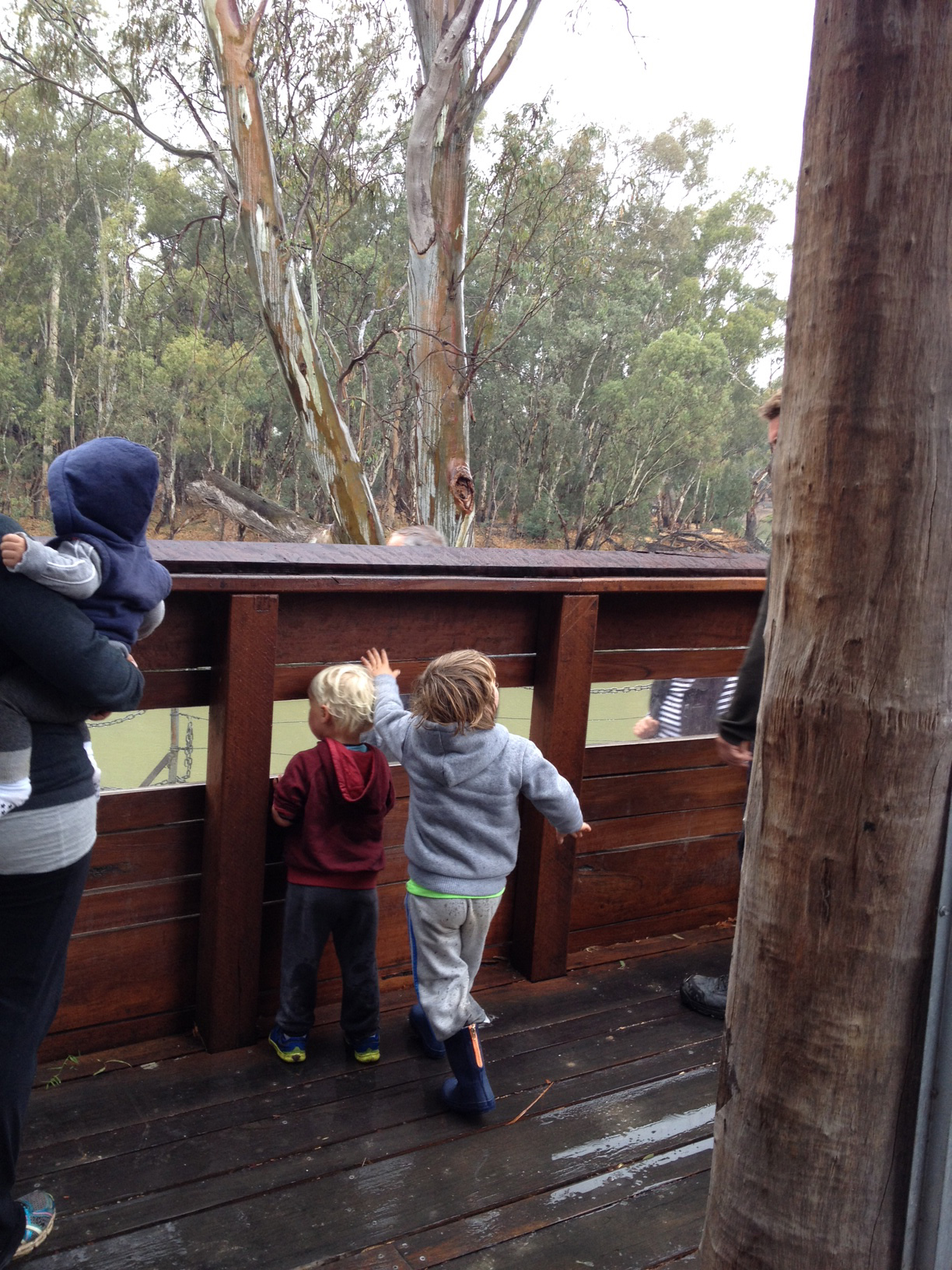
It was a rainy day yesterday as we were walking around the Port of Echuca.  It is the home of the largest collection of working paddle steamers in the world. Daily they paddle up and down the Murray river. At one point along the dock you can walk onto a section that looks out over the river. There is a protective fence where the designers have simply, but cleverly, placed glass panels at “little children” height so that they can look out too.  We were there as two small boys, fresh from jumping in puddles, saw these windows, raced up, looked out, and were thrilled by the sights.

If only churches could see this wonderful metaphor. Too often in worship the fences are that high that only the adults can “see” or experience what is going on. For children the service is an hour and 30 minutes of tedium, or they are sent out to “jump in a few puddles” while the adults do the real thing.

Too many churches, in my experience, either ignore the fact that there are children in church or send them out to be entertained elsewhere. There are no “windows” to enable them to participate and adults are often unable or uwilling to hold them up to see over the fence. So the implied message children receive is that there is nothing here for you. In other words, the view, or real worship, is essentially for adults only.

Children are people of God too. Children are called by Jesus as well. Children are in fact a model for us to follow. “Unless you become like one of these …” Too often however, children are left behind a windowless fence and not included and left out of the worship dialogue altogether.  They are not given a position from where they can be part of, experience and participate in the worship of the whole family of God.

Picture 011

The Port of Echuca on a sunnier day with some of its paddle steamers.

What can we do to give children kid high windows from which, they too, can be part of the worship by the people of God? What can we do as worshipping communities to reduce the walls which prevent children from being part of the singing, listening, praying, reading. giving and hearing that is our dialogue with God on a Sunday?

Churches are losing young people in droves.  What are we doing to make worship an unmissable part of their lives?  One part of the answer is to ensure that the child’s place in the community of worshippers is real and appreciated as well as age appropriate – that they can see through the fences. This does not mean that the worship service needs to be “dumbed down”, but it does mean that the worshipping community needs to think of genuine ways in which children, in fact all ages, have a meaningful encounter with their God when the community gathers for public worship.

I would even suggest that if we as adults are more intentional about including children, that is, giving them “windows” and holding them up, that we too will be enriched by the process. Moreover, and most importantly, God will be honoured and worshipped with greater integrity, as all His children gather before Him.

Categories: Child Theology, Children | Tags: , , | 3 Comments

Blog at WordPress.com.