Posts Tagged With: Faith

Razed by Fire

The Beautiful Alesund Rebuilt After the 1904 Fire

When we were travelling through Norway an amazing recurrent theme started to appear: fire. Many towns, being built of wood, had serious town-wide fires in their history. Trondheim had 9 between 1598 and 1842. Bergen had a few and Alesund was totally destroyed in 1904.

Albert Einstein is supposed to have said that insanity is doing the same thing over and over again and expecting a different result. May be we are all a bit insane. A bit of the Norwegian town builder resides in each one of us. There are so many unproductive habits and sins in our lives that we don’t deal with. We walk old paths hoping to get to a different destination and we are surprised when nothing has changed.

After the Great Fire of London in 1666, building regulations were changed: houses had to be faced with bricks and roads were widened. The Government of the day was keen that this fire would not happen again. Too often we are not that wise.

We need to take similar action. We need to change our ways. In Acts 2 we are reminded by Peter that the Holy Spirit enables us to repent and believe. “Repent and be baptized, every one of you, in the name of Jesus Christ for the forgiveness of your sins. And you will receive the gift of the Holy Spirit.” We don’t have to change our habits in our own futile strength. It is a journey that God goes on with us. Once we have come to Him in faith, His Holy Spirit remains to give us power over foolishness and sin.

What “fires” repeat themselves in your life? Is there a wiser material to use in the future?
Categories: christian, Christianity, Devotional, Faith, Uncategorized | Tags: , , , | 2 Comments

Titling at Windmills

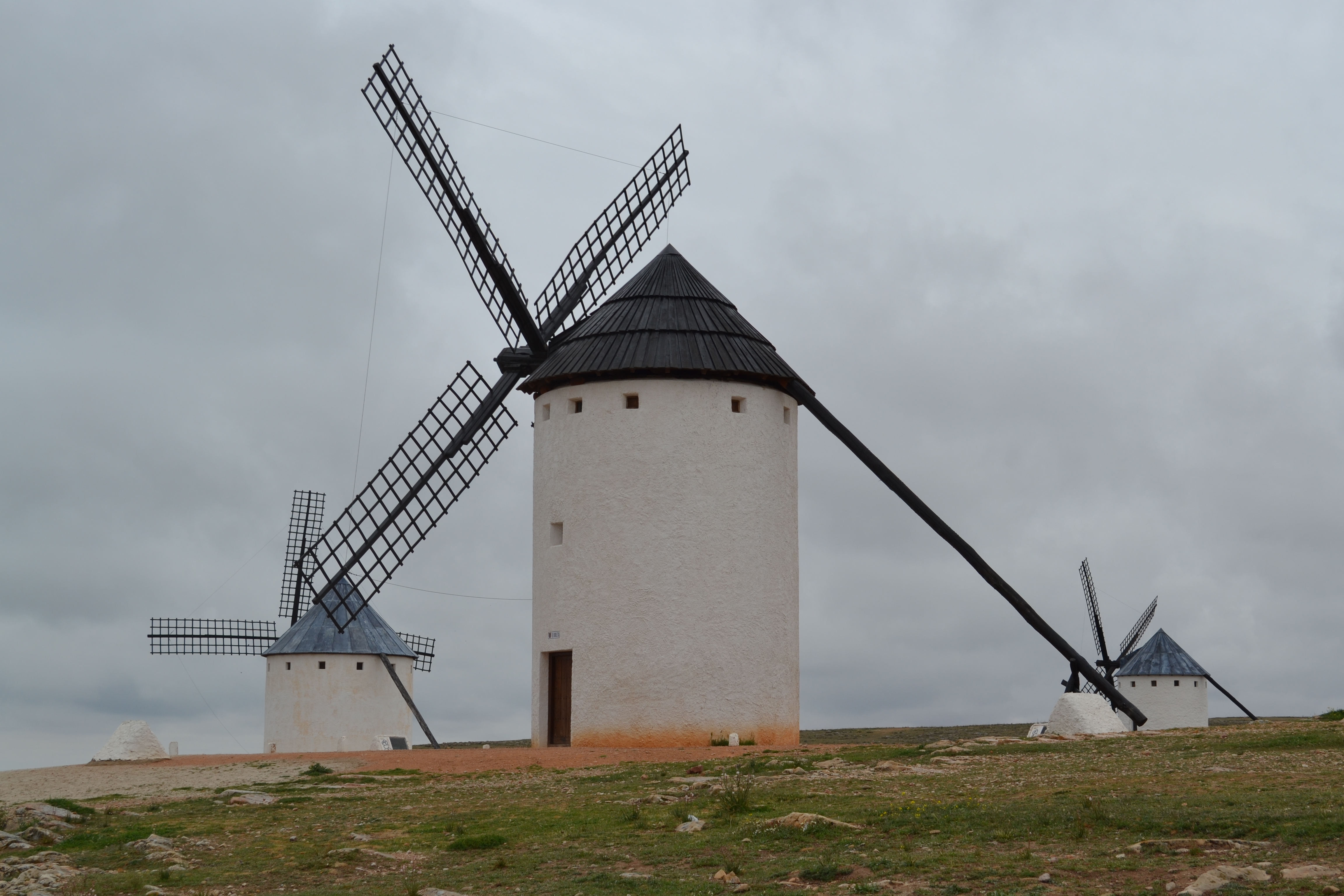
The Windmills of La Mancha

Every day they continued to meet together in the temple courts. They broke bread in their homes and ate together with glad and sincere hearts, praising God and enjoying the favor of all the people. And the Lord added to their number daily those who were being saved. Acts 2:46 & 47

One of my favourite characters in literature is Don Quixote. With a sense of honour and justice he sallies forth to defend the honour of his lady Ducinea. The truth is that he attacks windmills thinking that they are the enemy and gets gets involved in all sorts of preposterous behaviour, assuming that he is doing good. Even Dulcinea is a figment of his fervent imagination. Faithful Pancho supports his master but knows the truth.

When I explore the idea of “church’ I get a sense that I am like the deluded Don tilting at windmills and passionate about something that doesn’t really exist. Reading Acts, imperfect as the church was, they still had something special. There was a community living in excited expectation, sharing and supporting each other.

What is there in our Western C21st culture that blinkers us to the enormous potential of the church? What binds us? Is it our wealth and materialism or our lack of faith? Or is it the fact that we have been “doing it this way” for so long we fail to see the possibilities?

In the last two years I have been to many churches and I have seen wonderful things: programmes, passion, solid preaching, functional buildings and friendly people. Yet I still sense that somehow we are missing the point.

Am I the only one? Are Don Quixote and I closer than I think?

Categories: christian, Christianity, Church, Faith, Uncategorized | Tags: , , , | 4 Comments

The Death of Innocence

Lately I have been exploring the “calling”, “vocation” or “office” of children, that is, the the role they have in the plans of God and His people. We know they need to be disciplined and taught but children also have a role in reminding us of faith, trust and wonder – among other things.

Our society in recent generations has been destroying that naivety. Our children are becoming old before their time. As I write this a local retail chain is being criticised for selling “tramp” or “hooker” style clothes for young girls. This is only the tip of the iceberg.

The challenge for Christian homes is to allow children to grow up at a pace that is wise, healthy and godly. This pace allows the child to comprehend faith with a sense of wonder and certainty without the cynicism and crassness of the world cascading in. I know the early years of family life with young children can be tense and busy, but take time to allow your children to be in awe of God and to explore faith in a positive environment.

I know we can’t hold the world’s ideas back from our homes, but we can use those crucial early years to prepare our children for the onslaught.

Categories: Child Theology, christian, Christianity, Church, Devotional, Faith, Family | Tags: , , , , | 2 Comments

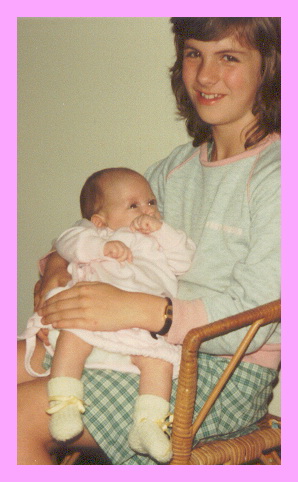
The Baby – A Calling

Helpless!
Following the path
of God incarnate
the child enters
into life
with genetic markers
stumbling parents
and
future choices.
 
Already,
her calling
is clear and sharp.
She cries praise to God,
and gazes in amazement
at every light and face,
movement and sound.
Wonder fills her eyes
as her mouth explores shape
and texture
while arms and hands
flail with random abandon.
 
She will be taught
in time
but now
she teaches us
the naïve joy of life
and newness
trust and hope.
She preaches a gurgling word
straight from the Maker.
Categories: Child Theology, christian, Christianity, Devotional, Faith, Poem, poetry | Tags: , , , , , , | 2 Comments

A Prayer With Which to Start Sunday

I found this beautiful little hymn in Marva J Dawn’s book, “Is It  Lost Cause? Having the Heart of God for the Church’s Children” It is a great prayer with which to start this Lord’s Day. The hymn is by the C19th Moravian, Frederick William Foster.

To Thee our vows with sweet accord,
head of your church, we pay;
we and our house will serve you Lord;
your word we will obey.
Grant us and all our children grace
in word and deed your name to praise,
and in each family, your will 
and purpose to fulfil.
 
Categories: christian, Christianity, Devotional, Faith, hymns | Tags: , , , | Leave a comment

Covers, Books and Poor Judgement

The story goes that Opa, an esteemed boat builder, was so opposed to the marriage of his only child, a daughter, (my grandmother) to my grandfather, a common house painter, that, at least on one occasion, he physically separated them on a public street.

Over a hundred years ago social class was still a serious means by which everyone was put in”their place”. It was an era in which the local noble in Holland  would arrive at church and be the first to enter with his family. After all it was a pew that he had paid for. Only after this had happened could the riff raff take the other places.

Quite a few years ago two theological students did an experiment. One dressed up neatly and the other poorly. They set about visiting local churches and measuring the reaction they got; how many greetings, invitations and conversations etc. It will not surprise you to know that the well dressed student was warmly greeted far more than the poorly dressed student.

A number of years ago I went on a retreat that was also attended by a number of Christian bikers- tattooed, chained, leather jackets, long hair (if they had any). To be frank they looked a scary bunch. I kept my distance. As I got to know them they revealed the most caring and gentle hearts I have ever come across. They invited street kids, and unwed mothers and people struggling with addictions to live in their homes. They were reflections of their master – Jesus.

I was ashamed of myself and reminded of what the Lord said to Samuel, “ … The Lord does not look at the things people look at. People look at the outward appearance, but the Lord looks at the heart.” 1 Sam 16:7

Categories: christian, Christianity, Church, Devotional, Faith | Tags: , , , | Leave a comment

The Struggle for Innocence

In the 2003 German film “Goodbye Lenin” we see the coming down of the Berlin wall  in 1989 through the eyes of Alex, a young East German man. The gist of the story  revolves around an incident where his mother has a serious heart attack and is in a coma  at the time the wall comes down. She awakens well after the event. But as she isn’t allowed to have any shocks no one tells her about the momentous changes in Germany. The story then explores this dilemma.

I have often wondered how a saint, who died in the 1950s, would respond to our Christian lifestyle if they were to return more than 50 years later. How would they react to the television and film content we consume or the magasines and books we allow in our homes? What would they think of our language and priorities?

I am prudish enough still to be offended by the crass language now so common in films, and the revealling catalogues that ordinary department stores send out. Photos only found in men’s “girlie” magasines in the 50s now seem quaint in comparison to the magasines I see at the supermarket check out.

“Times change,” I am told. “We can’t stop it,” says another. True enough, but it is more the unthinking acquiescence that troubles me. I don’t pretend to have answers but all these small examples are evidence for a far deeper malaise: the depreciation of values and ideals – even, or should I say, especially, in Christian circles.

In Philippians 4: 8&9 Paul gives us a Christian vision: “Finally, brothers and sisters, whatever is true, whatever is noble, whatever is right, whatever is pure, whatever is lovely, whatever is admirable—if anything is excellent or praiseworthy—think about such things. Whatever you have learned or received or heard from me, or seen in me—put it into practice. And the God of peace will be with you.”

In this passage Paul is reminding his fellow workers that as they pursue and prepare for Christ’s kingdom there is a lifestyle that goes with it. It is a lifestyle that reflects our Saviour and King. We are His ambassadors. As we serve Him even the little things count because they give evidence of what is in our hearts.

Too often we forget that one of the most powerful witnesses we have to our neighbours, workmates and friends is the way we live our lives: To use an old hoary phrase: “Walk the talk.” But walking the talk can easily turn into legalism. Really it must be more than that. It is walking the very relationship in Christ that impels our lives. Because of Jesus’ sacrifice for me my passionate desire is to become, in His strength, what He wants me to be. That is my witness – Christ in me.

I know that I need to do a constant audit of my heart. What about you?

Categories: christian, Christianity, Church, Devotional, Faith | Tags: , , , | 1 Comment

Human Will Versus God’s Will

For prophecy never had its origin in the human will, but prophets, though human, spoke from God as they were carried along by the Holy Spirit. 2 Peter 1:21

The temptation to make God in our image is great. It is, arguably, the most extreme form of arrogance aside from blatant atheism. Yet we are all so easily tempted by it. A few days ago I mention the prosperity gospel. Those of us with property want to justify our greed so we manipulate Scripture to “bless” our avarice.

Similarly, we construct a god who justifies our values and worldview. It is convenient but spiritually bankrupt.

Peter makes a clear statement that the Word of God comes from God Himself. Implicit in Peter’s picture is the triune God. Father, Son (Word) and Spirit are active in presenting God’s will and plan to humanity. Peter also stresses that its origin is miles away from our broken hearts.

So an approach to God that is humble and faith-filled will be blessed as God speaks directly to the needy heart through His Word and Spirit.

Categories: christian, Christianity, Devotional, Faith, Second Peter, Uncategorized | Tags: , | Leave a comment

The Father Sacrificing Dignity

Wearing a linen ephod, David was dancing before the Lord with all his might, while he and all Israel were bringing up the ark of the Lord with shouts and the sound of trumpets. 2 Sam 6:14&15

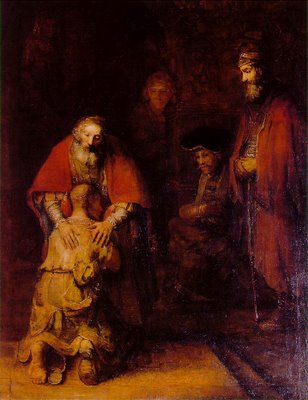
But while he was still a long way off, his father saw him and was filled with compassion for him; he ran to his son, threw his arms around him and kissed him. Luke 15:20

When the soldiers crucified Jesus, they took his clothes, dividing them into four shares, one for each of them, with the undergarment remaining. John 19:23

Rembrandt’s “The Prodigal Son. Courtesy: Google Images

On Sunday evening I heard a young man preach his first sermon. It was on the prodigal son. There was much to commend but one phrase leapt at me. When the father ran towards his returning son the young preacher stated that “he sacrificed his dignity.” It was one of those phrases that invites immediate reflection and meditation. The further I thought about it the greater the realisation that more God has dealt with a rebellious and sinful humanity the more our heavenly father sacrificed his dignity – set apart the honour and glory that is His due and came into our chaos to free us from our self inflicted mess.

What we see a glimpse of in David, and the dad of the prodigal son, we see perfectly in Christ. The son, whose rightful place was and is beside the father, came to earth as a human being and died at our hands so that our condemnation would dealt with. That is sacrificing dignity – sacrificing all that is rightfully his for the our sake.

But, I thought, do I really comprehend this sacrifice? Do we as the church understand this? I am thinking particularly of the middle class church in which appearance, reputation, success and honour are so important. If Jesus sacrificed, not just his dignity, but his life for us, how I do I/we reflect that reality in the way I/we “live” our Christian lives and “live” church?

Inspired by Rembrandt’s painting of the prodigal son, the respected Catholic theologian, Henri Nouwen left his University post and began caring for, and cleaning up after, mentally ill patients. Nouwen glimpsed what my young friend alerted me to on Sunday night – to be Christlike requires us to sacrifice our dignity. To be like Jesus means to sacrifice all for the kingdom – even what people think of us!

Categories: Calvin, Camino, christian, Creation, Ethics | Tags: , , , | 1 Comment

Holy Sonnet 14: Batter My Heart

Batter my heart, three person’d God; for, you
As yet but knocke, breathe, shine, and seeke to mend;
That I may rise, and stand, o’erthrow mee,’and bend
Your force, to breake, blow, burn and make me new.
I, like an usurpt towne, to’another due,
Labour to’admit you, but Oh, to no end,
Reason your viceroy in mee, mee should defend,
But is captiv’d, and proves weake or untrue.
Yet dearley’I love you,’and would be loved faine,
But am betroth’d unto your enemie:
Divorce mee,’untie, or breake that knot againe,
Take mee to you, imprison mee, for I
Except you’enthrall mee, never shall be free,
Nor ever chast, except you ravish mee.

John Donne 1572 – 1631

A statue of Donne dressed in his funeral shroud in St Paul’s London. Courtesy: Google Images

Once again I would like to return to this poem by John Donne. In this most honest of poems he reminds us of the struggle to be sanctified – made holy. In terms of a medieval blacksmith beating his iron, or city under attack he calls on God to take him captive because otherwise he would be the “enemie’s” captive. In an almost shocking and ironic line he asks God to “ravish” him to make him “chast”.

Time and again when I read this poem I am struck by Donne’s use of human love as a metaphor for God’s love. Even his relationship with Satan is described in terms of betrothal. But is it really that strange? The relationship between man and wife, at its best, is a wonderful image of love. Christ, himself, speaks in terms of a bride and bridegroom when he refers to himself and the church.

Donne’s poem is also a reminder in the current debate about marriage that Christians are called to demonstrate with their lives and voices what a Biblical view of marriage is. It is the greatest weapon we have in promoting marriage as God intended. After all, Jesus uses it to give us an insight into our relationship with him. This is something John Donne understood.

Categories: christian, Christianity, Devotional, Faith, Poem, poetry, Uncategorized | Tags: , , , , | 2 Comments

Blog at WordPress.com.