Child Theology

Keep The Drawbridge Closed

A few days ago I started a discussion on how we direct our children with regard to faith in this chaotic post-modern environment. The story continues …

How do we guide our children in the fraught area of faith? Some parents try to surround their children with their values and beliefs and keep all other views at bay. We could call this a fortress approach. This method of  parenting, especially in the area of faith, is very understandable. It can be a very nasty, seductive and confusing world out there. So these parents tend to limit the contact their children have with the outside world. TV and the internet is controlled, friends are screened and if at all possible they are home schooled. (I am not suggesting this the motive for all home schooling parents).

20120502-204846.jpg

Some parents try the fortress approach.

Is this approach sustainable? I would suggest not. It might be appropriate at young ages but there is also a need for our children to argue for their faith and to justify their beliefs. (I’ll say more about this in the future). The time will come when they are confronted by the world and they will need the foundation and the tools to withstand the onslaught, and advance their faith and worldview. In other words, it is naive to believe that only protecting them is sufficient to plant and grow a healthy and lasting faith.

I have seen too many young people lose their faith when they have gone to university or work for the first time and they haven’t had the where-with-all to counter and defend themselves against the worldviews, thinking and values that others hold. Why? Simply, because they hadn’t been prepared.

So how do we prepare them? More tomorrow.

Categories: Child Theology, christian, christian education, Devotional, Faith, Family, Reflections, Uncategorized | Tags: , , , , | 3 Comments

Let them Choose

Yesterday I wrote about the confusing “world of faiths” that has developed in Western countries over the last few generations. It is this faith supermarket that our children enter. I didn’t even mention celebrities and Scientology, or the crazy “God will make you rich” fringe of the Christian church – attempts to justify consumption and not feel bad about it. Also I didn’t mention the impact of the marginalisation of the Bible in many churches and the resulting liberalism and watering down of the gospel.

So how do we guide our children? One stream of parents I come across say that we shouldn’t guide our children. “Let them make up their own minds in their own good time. If Christianity is the best faith or the most suitable faith for them they will find it in time. We have an open family where all things are discussed and in time they will chose for themselves. After all, what we believe may not be the best thing for them.” A very open approach.

There are two things I want to say about this:

1. It is not an approach we would use in other areas of life. “Children will discover for themselves the need to brush their teeth, and wash their hands after having been to the toilet. If they wish to follow our example they can, if they don’t, that is their own choice.” We would call that neglect. The result would be rotten teeth and hepatitis Anyone who said this would be considered dim. “When the child decides that school is for them, then they will go to school or be educated.” We can imagine a host of other situations like this. Why then do we do this with faith? I believe the answer is simple. We have consigned it to the less important areas of life. Faith is personal, individual and not part of the mainstream of life. It is not worth the parental investment required. We will encourage sport and music, but not faith.

2. My second point is that this approach is the antithesis of what Scripture commands.

Breakfast Under the Big Birch Tree - Carl Larsson

Breakfast Under the Big Birch Tree – Carl Larsson

Teach your children at every opportunity (Deut 6), train your child (Prov.22:6), do not hinder them from entering the Kingdom (Matt 18). God’s approach, the Bible’s approach is that children are precious and so need to be nurtured in eternal truths – the character of God, the nature of salvation and their place in His Kingdom, from an early age. This takes intention and time, effort and passion, faith and family. Scripture suggests that nurturing children is one of the most important, if not the most important, calling a parent has. There is no place for a laissez faire attitude.

We guard them from live power points, suspicious people and moving cars, so why don’t we protect their eternal souls from the clutches of the evil one?

Next I want to look at the opposite approach: Blinkering the child from other faiths.

Categories: Child Theology, christian, christian education, Christianity, Devotional, Faith, Family, Reflections, Uncategorized | Tags: , , , , , | 6 Comments

Child Theology

In reference to Mathew 18

The child placed by Jesus is beside Him to serve as a sign of the Kingdom of Heaven. So the child (about whom we know nothing except that he or she was little and lowly in status) is only to be the object of attention, care or veneration insofar as that is inherent in being a sign of the Kingdom of God. Child Theology starts with Jesus and asks what light children throw on God, the Father, Son and Holy Spirit and His way of doing things in His world (that is, the Kingdom of Heaven). This light immediately exposes the way the disciples are thinking and behaving, and their fundamental misjudgement of Jesus and the Kingdom. Put simply, if not crudely, Jesus was telling them that they had got the Kingdom of Heaven all wrong! It wasn’t just that they were a bit off course: they were on completely the wrong track. Child Theology seeks always to have the child placed by Jesus in the midst of conversations and reflections, but it is concerned with every aspect of God’s mission, and involves the whole community of God. It will lead us all to see that in welcoming children we welcome Jesus, and the One who sent Him.

From: Introducing Child Theology
Theological Foundations for Holistic Child Development
REVISED EDITION
KEITH J. WHITE

20130425-165731.jpg

Categories: Child Theology, christian, Christianity, Reflections | Leave a comment

Moralistic Therapeutic Deism

My wife, who is passionate about children’s ministry, introduced me to a study that I had not previously heard about. In 2005 Christian Smith and Melinda Lundquist Denton wrote a book entitled: Soul Searching: The Religious and Spiritual Lives of America Teenagers. (I have to stress, I have not yet read the book only the paper by Smith referenced below.)

After interviewing 3000 teenagers they suggested that there is a “de facto dominant religion among contemporary teenagers in the United States …  what we might call “Moralistic Therapeutic Deism.”

Smith and Denton suggest that there are a number of key beliefs to this creed, namely:
1. A God exists who created and orders the world and watches over
human life on earth.
2. God wants people to be good, nice, and fair to each other, as
taught in the Bible and by most world religions.
3. The central goal of life is to be happy and to feel good about oneself.
4. God does not need to be particularly involved in one’s life except
when he is needed to resolve a problem.
5. Good people go to heaven when they die.

If this research is accurate, and there is no reason to suggest it isn’t, we have a scary, self centred religion among many of our young people. I might add that the noise coming out of many churches is not that dissimilar. Prosperity theology is just one example.

The findings of this research have massive implications for the church: What it teaches, how it teaches and the centrality of Scripture in that task. The five beliefs above are at best half truths and at worst poisonous corruptions of the truth that will stifle and destroy Christian faith and discipleship.

Christian Smith closes his paper by writing:
The language—and therefore experience—of
Trinity, holiness, sin, grace, justification, sanctification, church, Eucharist,
and heaven and hell appear, among most Christian teenagers in the United
States at the very least, to be being supplanted by the language of happiness,
niceness, and an earned heavenly reward. It is not so much that Christianity
in the United States is being secularized. Rather more subtly, either
Christianity is at least degenerating into a pathetic version of itself or, more
significantly, Christianity is actively being colonized and displaced by a quite
different religious faith.

I can’t help thinking that this development describes more than only teenagers. In my recent travels around a variety of churches in Australia I have been astounded how often I have heard pop psychology and “feel good” messages rather than the proclamation of Word of God. A return to God’s Word and its claims on our lives must be the starting point for the rescuing of lives – hearts and minds.

Reference:

Click to access Smith-Moralistic.pdf

Categories: Child Theology, christian, Christianity, Church, Moralistic Therapeutic Deism | Tags: , , , , | 3 Comments

Narrating the World to Your Child

These commandments that I give you today are to be on your hearts.  Impress them on your children. Talk about them when you sit at home and when you walk along the road, when you lie down and when you get up. Deut 6:6&7

This morning I was listening to a radio program about teaching young children to read. Two experts in the area were reflecting on the important factors that encourage literacy. In amongst the usual ideas (read to your children, have books lying around the house, find good apps etc.) one idea resonated in particular. That is: Parents with young children should narrate the world to them. “Mummy is going into the kitchen to get the red bowl.” “Daddy is putting on a woolly jumper.” The idea is that you introduce the child to both words and conversation at an early age while going about your daily duties. Many parents do that quite naturally. Objects and names are connected and actions identified. There were also another host of positives.

100_9680 cropBut do we narrate the the world to our children at a spiritual level? Are we developing their spiritual literacy? In our words and actions, are we reinforcing Christian values and Biblical concepts? Our actions have moral and value laden implications – our children need to know the underpinning that informs what we do. Our children need to learn right behaviour but what is even more important is the right thinking that shapes our behaviour.

Moses, in Deuteronomy 6, understood this. In an age when values are thin on the ground the child of Christian parents needs to be continually shaped by Biblical standards. “We are helping at the the shelter on Christmas Day because Jesus wants us to look after the less fortunate.” “You don’t talk to your mother like that because God wants us to honour our parents.” That second example needs to be demonstrated when you visit your parents or when you talk about them at home.

If we consciously narrate the world spiritually, whether watching TV with issues that arise, debriefing a day at school or simply having dinner, we and our children will be blessed as both parent and child are reminded of the “reason why” we behave and live in a particular way.

Categories: Child Theology, christian, Christianity, Devotional, Faith, Reflections | Tags: , , , , | Leave a comment

Through the Praise of Children and Infants …

Through the praise of children and infants
you have established a stronghold against your enemies,
to silence the foe and the avenger. Psalm 8:2

It Is Time To Bless Our Children

Our children are called to praise God

In Psalm 8  David is astounded as he reflects on minuscule man in God’s vast cosmos. “Who are we when the universe is so big!” So the fact that we are a little lower than the angels, and rulers over creation is even more amazing. Humanity is important to God.

But I believe the most extraordinary verse is verse 2. Within the cosmos, the praise of children and infants can silence God’s enemies! The smallest of the small in the vast halls of God’s universe have a place front and centre to bring glory to God.

The praise of Children is close to God’s heart. This Christmas churches will have nativity plays and choirs. However the praise of children to God should be front and centre all year round in church, home and school. Children’s praise is not just for Christmas and Easter.

When our naive and vulnerable children sing praises to God and shake His enemies we have evidence of God’s faithfulness. When we parents, adults and leaders only trot them out at Christmas we are stifling our children and their place in His Kingdom.

Categories: Child Theology, christian, Christianity, Church, Devotional, Faith, Reflections | Tags: , , , , | Leave a comment

The Death of Innocence

Lately I have been exploring the “calling”, “vocation” or “office” of children, that is, the the role they have in the plans of God and His people. We know they need to be disciplined and taught but children also have a role in reminding us of faith, trust and wonder – among other things.

Our society in recent generations has been destroying that naivety. Our children are becoming old before their time. As I write this a local retail chain is being criticised for selling “tramp” or “hooker” style clothes for young girls. This is only the tip of the iceberg.

The challenge for Christian homes is to allow children to grow up at a pace that is wise, healthy and godly. This pace allows the child to comprehend faith with a sense of wonder and certainty without the cynicism and crassness of the world cascading in. I know the early years of family life with young children can be tense and busy, but take time to allow your children to be in awe of God and to explore faith in a positive environment.

I know we can’t hold the world’s ideas back from our homes, but we can use those crucial early years to prepare our children for the onslaught.

Categories: Child Theology, christian, Christianity, Church, Devotional, Faith, Family | Tags: , , , , | 2 Comments

The Baby – A Calling

Helpless!
Following the path
of God incarnate
the child enters
into life
with genetic markers
stumbling parents
and
future choices.
 
Already,
her calling
is clear and sharp.
She cries praise to God,
and gazes in amazement
at every light and face,
movement and sound.
Wonder fills her eyes
as her mouth explores shape
and texture
while arms and hands
flail with random abandon.
 
She will be taught
in time
but now
she teaches us
the naïve joy of life
and newness
trust and hope.
She preaches a gurgling word
straight from the Maker.
Categories: Child Theology, christian, Christianity, Devotional, Faith, Poem, poetry | Tags: , , , , , , | 2 Comments

What Do You Remember?

What are your earliest memories? I asked myself that question the other day. In a bit over week’s time I turn 62 years young and so I began reminiscing about my earliest years.

Here are some memories up to the age of 3 and a half years:

  • Sitting under a desk listening to the warm conversation of adults at my grandparents’ home.
  • Visiting a great grandfather whose false leg was standing in a corner – that made quite an impression.
  • Visiting the barber who had a jar of lollies/sweets behind the counter.
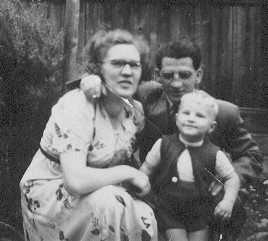
  • Sitting on the grass in a local square reading a picture book. (This one is reinforced with a photo of the event)
  • Checking my aunt’s pocket with my foot as she was holding onto me and hugging me to see if she had brought me a treat.
  • “Reading” Bible story books and having them read to me.
  • Being separated in child care from my parents on the migrant boat to Australia.

There are many more but these are a few that stand out. The overwhelming emotion that comes from remembering these is security and warmth. I was loved by my parents and my extended family. What a privilege that was and what a joy to remember! I hope that my children have similar memories.

It also leads to me to think of the great number of children today for whom those early years are not surrounded with joy, but in contrast, with pain and neglect.

When you cast your mind back to your earliest memories, what comes back to you?

Categories: Child Theology, christian, Christianity, Devotional, Family | 8 Comments

Why Does God Use Children in His Plans?

After having written the last two posts connected with “Child Theology” I asked myself the question in the title.

And I have a few suggestions but I would love to hear what readers think too.

My first thought is that children are imaginative and spontaneous. For too many of us, the older we get, the less spontaneous we become and we are governed by what other people think and past failures. Children are not bound by that.

My second thought is that God’s uses the young at their stage of development. I have some suggestions from the Bible to back my ideas up.

When Joseph had his youthful dreams about his brothers and family, aged wisdom would have told him to keep his mouth shut. Experience tells us that blabbing these dreams would be a mistake. However Joseph in his immaturity and ego centered youthfulness informs the family. Even his dad was annoyed. Foolish as this was, Joseph’s actions ultimately led to his family’s rescue from starvation.

God used Miriam as the responsible older sister care for her baby brother.

Other events include Isaac’s childlike innocence when being prepared as a sacrifice and David’s childlike faith and idealism when facing Goliath. There is also Samuel’s childlike openness to the idea that God was speaking to him. How many of us would have been that open?

My contention is that God used young people because they had qualities that age had removed from the next generation. Are we missing out on the qualities of our young people simply because we are judging and assessing them on a maturity that we may have but that they haven’t reached?

What are we as churches and families missing out on by not recognising that childishness and youth also have a place in the kingdom?

Categories: Child Theology, christian, Christianity, Devotional, Faith, Uncategorized | Tags: , , , | 2 Comments

Blog at WordPress.com.