Christianity

The Lure of the Occult

St Michael's Victory over the Devil, a sculpture by Sir Jacob Epstein

St Michael’s Victory over the Devil,  by Sir Jacob Epstein

I remember back in my high school days, last century, that every now and then an occultic fad would pass by: Ouija boards, seances and even palm and tea leaf reading. People have this “spiritual” itch that they want to scratch with these practices.

There is an excitement about dabbling covertly in these unknown realms. Many people have done it from Arthur Conan Doyle (who seemed so logical in his Sherlock Holmes stories!) through to the notorious Rasputin plus many, many more.  Every age seems to have its own versions and own followers. The latest incarnation is a game called Charlie Charlie.  The interweb has made the progress of this and other modern fads more immediate. A few days ago the SMH reflected on the speed at which Charlie Charlie had progressed.

Now it is easy to say that most people who engage in these facile games are not impacted for the long term.  But why does Scripture exhort us to steer clear of these activities? In Ephesians 6: 11 & 12 Paul reminds us to equip ourselves with the full armour of God: Put on the full armour of God, so that you can take your stand against the devil’s schemes.  For our struggle is not against flesh and blood, but against the rulers, against the authorities, against the powers of this dark world and against the spiritual forces of evil in the heavenly realms.” In other words, there is a realm of existence about which we not only need to be very wary but we also need to consciously protect ourselves. And if we don’t dabble in it we don’t have to be fearful either and the child of God will be protected.  Second Thessalonians 2 reminds us of the “lawless one” whose aim it is to encourage us to serve the lie – that is Satan.

When we read the Old Testament we also find many frightening passages which literally damn these practices as they are in direct contravention of the first four commandments.  God doesn’t mince His words when He speaks of divination, sorcery and its practitioners.

As parents and teachers we need to be sensitive and aware of this discussion.  Some young people may be just playing a foolish game, for others however, there may be a real spiritual longing – one that we could tap into and nurture in healthy directions. An added concern is the alarming prospect that there may be those for whom these games act like a gateway drug and introduce them to more worrying and even more sinister activities.

Whatever the situation, this latest fad is a clear reminder to be vigilant and to protect, educate and nurture those in our care or sphere of influence in ways that enhance and protect their spiritual and eternal welfare.

Here are a few helpful resources on the Web:

http://www.christiananswers.net/q-eden/edn-occult.html

http://studentsoul.intervarsity.org/occult

This has a useful list of texts further down the page.

http://www.gospelway.com/religiousgroups/witchcraft.php


Categories: christian, christian education, Christianity | Tags: , , | 5 Comments

The Wesleys’ Hymns

This past weekend my wife and I attended a Wesley Hymn Fest, where, as you can imagine, we were led in the enthusiastic singing of Wesleyan hymns.  Now I don’t come from the Methodist tradition but there was something very special about 250 people being led by a small group of musicians, pipe organ and choir, declaring in song  messages of hope, faith and truth.

I was struck by the wonderful words of the hymns.  Charles Wesley, often assisted or supported by brother John, knew his Scripture and wove this understanding into his verses.  Many hymns were inspired by particular Bible passages, or were Bible passages put to music. In response to Isaiah 51:9 he penned:

Arm of the Lord, awake, awake!
Thine own immortal strength put on!
With terror clothed, hell’s kingdom shake,
And cast thy foes with fury down!

The hymns also reveal a great understanding of the human condition. In an era when many children died young one can feel the tension of faith and pain that Wesley was only too familiar with in a hymn we didn’t sing last Sunday:

Dead, dead! the child I loved so well!
Transported to the world above!
I need no more my heart conceal;
I never dared indulge my love:
But may I not indulge my grief
And seek in tears a sad relief?

The language is quaint but the messages are still intimately personal:

My God, I am Thine, what a comfort divine,
What a blessing to know that my Jesus is mine!
In the heavenly Lamb thrice happy I am,
And my heart it doth dance at the sound of His name.

The image of the dancing heart is uplifting! Charles Wesley wrote nearly 6000 hymns which were often composed for special occasions. And still there were many others from the era who wrote fabulous hymns from John Newton’s Amazing Grace to Isaac Watts’  When I Survey the Wondrous Cross. Watts was a comparative sluggard as he only wrote 750 hymns. And there are others: William Cowper, Frances Havergal … and all the way back to Bernard of Clairvaux  to name only three.

In many churches today these hymns have disappeared under the weight of modern songs and choruses.  Every era is inspired by the Spirit anew but we shouldn’t forget these incredible songs from the history of the church – a history that extends all the way to the early church. In the case of the Wesleys it was a history of renewal and revival. It would be good if we had links to these brothers and sisters from the past every time we met in worship.

Here is one of my favourite singers singing one of Charles Wesley’s songs.  Maddy Prior and the Carnival Band also have a great album of Wesley’s songs called Paradise Found:

Categories: christian, Christianity, Church, hymns, Uncategorized | Tags: , , , | 11 Comments

Including Children in Church Community

There is a small but growing group of Christians who are eager to see the children of the church integrated into the life of the Church body and not just pandered to by programs. Although programs, in and of themselves can be quite useful, they can also stymie the discussions that churches and families need to have about faith formation in the life of their children. Programs by themselves often focus on knowledge (cognition) and what is missed is the beautiful mystery of faith and the excitement of disciple development.  I have written on previous occasions about the importance of the child’s vocation in the church. (Here is just one example).

Last night I heard David Csinos, who describes himself as an author, speaker, practical theologian, husband, researcher of children’s spirituality, and former children’s photo 4pastor, speak in Geelong. This was encouraging for a variety of reasons. It reminded me that there are more voices and often more articulate voices speaking out on this issue and it also caused me to reflect that this is not “rocket science” but requires families, churches and church leaders to engage in a prayerful discussion of how faith is developed in the most vulnerable and important members of our church communities.

If you wish to explore this important notion I have included some websites and books to explore:

  • David’s blog:   http://davecsinos.com/
  • The Journal of Family and Community Ministries (which is free to subscribe to): http://www.familyandcommunityministries.org/
  • A wonderful book is :  Children’s Ministry in the way of Jesus by Ivy Beckwith and David Csinos. This is a good place to begin your reflections if you haven’t started already, or to continue your journey.
  • Is it a Lost Cause: Having the Heart of God for the Church’s Children by Marva Dawn.
  • And if you look under Child Theology you will encounter more of my thoughts/musings on the issue.
  • Another worthwhile approach is taken by the Child Theology Movement.


Categories: Child Theology, Children, christian, Christianity, Faith, Family | Tags: , , , , , | 2 Comments

Greater Love

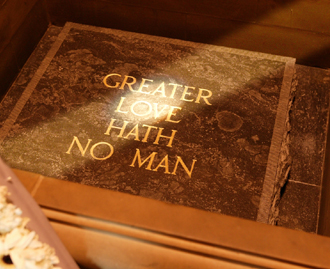
Photographic record of the Shrine of Remembrance, photographer unknownLast night my Literature students and I went to a performance of Shakespeare’s cross dressing comedy, ‘As You Like It’.  It explores love in many of its facets. How and why does it happen?  What does it do to us – for good or bad?  Is it different for men and women?  What external influences are involved? What about our motives? … and there are more uncomfortable questions.

But underlying all of that is the idea that love, romantic and otherwise, is an essential part of the human character. We all want to love and be loved. A life without love is empty and possibly meaningless.

And then this morning at our College’s  ANZAC  service our Senior School Captains spoke on the verse John 15:13  “Greater love has no one than this: to lay down one’s life for one’s friends.”  This is paraphrased in the War Memorial in Melbourne – “Greater love hath no man”.

This verse must be seen in the context of Christ reflecting on his own sacrifice and then suggesting to his disciples that this sacrifice in turn become a model for their lives. Accepting Christ’s love becomes the foundation of our desire to love like he does. Love, here, is a giving of one’s self for others. It puts others first, which is no doubt the reason for its presence in the War Memorial it highlights the Aussie ideal of mateship.

There is nothing amiss with the Bard’s exploration of love. He raises excellent questions and challenges us. However, the answers are not found in his plays, but rather in the gospel. Christ’s love becomes a model for our relations – romantic and otherwise.  Christ’s love doesn’t start with our own private swooning’s, or sexual desires but for the welfare and best outcomes for the other – friend and foe alike.

Shakespeare raises tough questions but Jesus gives us even tougher answers.

Categories: christian, Christianity, community, Uncategorized | Tags: , , | Leave a comment

Jesus Unicorn

Today my wife, Hetty, is presenting a guest blog on the topic of children and worship.

Jesus Unicorn

Courtesy Google  images

Courtesy Google images

A young girl was given a notebook and some colouring pencils and pens while she sat in the pew with her family.  After a few weeks, her parents suggested that she listen to the sermon while she drew. By the end of the sermon she had drawn some pictures of a unicorn with the words ‘Jesus Unicorn’ above them.  Her parents were amused.
 
Some questions:
 
  • What did her parents believe children should be doing in a worship service?
  • Did they give her any guidance about what she could do with the writing and drawing materials?
  • What was the underlying message the child got concerning how she should behave in the worship service and from her parents’ subsequent suggestion?
 
Some ideas:
 
If you were her parents, how might you encourage her to participate in the worship service?
How would you begin a discussion with this child about ‘Jesus Unicorn’ which could lead her to a fuller experience of worship?
 
Paper and pencils are fine to keep a child’s hands busy, to keep a child quiet, and even as a stepping stone to taking notes of the sermon but it should never stop there.
Children can draw the stories they hear (and they should be hearing God’s stories, not just theological concepts) or their feelings. There should be a clear understanding of when they can draw/write and when they should be participating in the singing, praying, etc.  Parents should follow up with the child later. It may help if the parents also occasionally used paper and pencils during the sermon, and the family shared their pictures afterwards.
 
A warning:
 
Be careful not to let this become another kind of ‘school’ activity.
Help the child to use the writing and drawing, as well as the words they’re hearing and the images they’re seeing, as a way to explore their understanding of God, and the worship of Him.
 
 
Hetty Stok
Categories: Child Theology, Children, christian, christian education, Christianity, Church, Uncategorized | Tags: , , , | 8 Comments

Confused World

I have been watching with concern and bemusement the attempts of our government to halt the execution of two Australians in Indonesia.  My hope and prayer is that they succeed even though this seems very unlikely.  However, this situation highlights the inconsistency of our society.  While huge efforts are being put into saving these two, thousands of unborn children are murdered every year without the legal challenges and TV and newspaper headlines.  The moral outrage at killing two Australians doesn’t match our government’s efforts with asylum seekers in detention.

The 6th Commandment, “Thou shalt not kill” is a declaration of the importance and value of life. It reminds us that humanity was created in God’s image.  In the words of John Donne, “Any man’s death diminishes me.” Human life is precious but governments and corporations have devalued them to “economic units”.  Movie producers and and game designers have made death a form of entertainment.  Even religions murder others to advance and justify their beliefs. Worse still, we have come to believe many of the corrupted messages that swirl around us today. In my naive and simple way I believe it is time to reclaim two truths: 1. Humanity was made in the image of God (a huge discussion just by itself!) and because of that, 2. Human life is precious. If we believed that passionately it would change the tenor of our discussions and behaviours.  Our view of others would begin to change and our view of ourselves would change.

As a Christian I understand that only the Holy Spirit changes hearts but we have a challenge and responsibility to remind ourselves and the world what a gift life is.

Categories: christian, Christianity, Church, community, Life, Uncategorized | Tags: , , | 9 Comments

Certainty in Uncertainty

After having written about my growing uncertainty about previously held facts and truths, my wife, as is her habit, challenged me to reflect further.  From a Christian perspective what is the value of this uncertainty?  Does it aid the Christian walk?  Does it help us grow?

15374634478_0527b03fbf_z (1)

We can feel as though we are  tossed about but that need not be the reality

This made me think and ponder even further.  As I stated previously, uncertainty hasn’t weakened or unsettled my faith.  The reality is that it drives me more into “the arms” of God.  It makes me more reliant on Him and increasingly highlights my own inability to know or understand all things.  There is a subtle (or maybe not that subtle) message in our rationalistic age that says we can know and discover all things.  But the old adage is true, “The more we know, the more we know we don’t know.”  Personally I have discovered this to be true and I am at peace with this because I know my Creator.

One more point: I remember years ago a friend was given a chart by his brother of sins and virtues and my friend’s brother was ticking off those virtues he had achieved and those sins he had conquered.  I have found reality to be far different.  The older I have become the more I have discovered that things need to be added to the “sin list”. My heart’s deceptiveness has shown itself more devious than I imagined as a 25 year old.  And my virtues maybe not as virtuous as I thought.  I remember when (a long time ago) for a moment I was quite proud of my humility until the irony of that hit me like a Mack truck.

This again drives me into the arms of a the God who loves me despite my foolish mind games and my uncertainty.

There is certainty but it lies far, far away from me.

Categories: christian, Christianity, Faith | Tags: , , | 6 Comments

Uncertainty

As I was sanding down an old cot this morning, in preparation for our first grandchild, my mind started to wander.  Afterall, sanding is boring. I reflected on the fact that the older I have become, the less certain I DSC_0432am of many things.

Views that I had held solidly in the past, now, were not as concrete as I thought.  I hasten to add that my faith, belief in God and Scripture are not among these uncertainties although interpretations of some key ideas are.  Some of these uncertainties may include interpretations of Scripture, but others are social and environmental. I was very conservative when I was younger but now I realise that I am on the left of many of my friends. Subtly and imperceptibly I have shifted over time.

I can think of a host of examples where my thinking has changed or mellowed. Whereas once I was a staunch supporter of the 6 twentyfour hour day version of creation – now I see many more (Biblical) possibilities. The role of women in church, the environment, my political views are just some more examples of where my black and whiteness has morphed into something far less concrete and certain.

Being certain has a comfortableness about it. I miss that. In many areas of life I can no longer say with unwavering confidence, “This is the truth and if you don’t believe it, you must be wrong.” You may have a point after all (Michael).

As I was sanding down the frame I wondered why this had happened.  Is it that the realities of life have washed over me?  Is it that now I see some many more complexities though simple experience?

I came to another conclusion although the above might also be true. I think it is mainly that my God is far bigger and more majestic than I ever imagined  60 or even 30 years ago.  The God of Scripture, the universe and life itself has a complexity and omnipotence that cowers my certainty.  His Word has a depth in which I often feel out of my own depth! My brothers in the past said with utmost certainty and conviction that the world was flat and at the centre of the universe.  What do I say now which must cause God to laugh at my puniness and ridiculousness?

That is why I am more uncertain than ever before – and in a way – I am content to be so.


Categories: christian, Christianity | Tags: , | 6 Comments

Amour

Recently my wife and I watched the acclaimed french film “Amour.”  The acting was stunning, the pace reflective and the themes challenging. The film introduces us to the twilight years of a loving couple, Anne and GeorgeAmour-poster-frenchs, at about the time Anne has a stroke. We then see the struggles that this stage of life introduces them to and their attempts to deal with that. 

I was amazed how much this film unsettled me. Films don’t normally eat at me so much and I began to ask why?

One reason that this film challenged me is that both my wife and I have lost our mothers in the last 5 or 6 years. It brought back painful memories. Helplessly watching people at the end of their lives is not a pleasant experience. Added to this was that it also brought back memories of difficult pastoral visits that I have made in the past. As a young (and when I reflect back, often clueless) pastor I assisted many people in these final years. Some people going with assurance and peace and others with fear and trepidation.

However, the most confronting aspect of the film was the reminder of my my own mortality. My wife and I maybe relatively healthy now but there is no guarantee as to how long this will last. One of us is going to look into a coffin to say goodbye to the other.  So the questions arise, how will I react as the carer or the one being cared for? How gracious and patient and forgiving will I be? My track record hasn’t always been that good.

The saddest aspect of the film was that faith and hope were largely absent. There was love and dedication and certainly a hint of Christ-likeness in their attitude toward each other but there was no future or eternity in view. So as unsettled as the film made me, the biggest reminder for me is to continue to stay focussed on Christ. My life here is a pilgrimage and not the destination.

Categories: christian, Christianity, Uncategorized | Tags: , , , | 4 Comments

They Will Know …

In my last blog I finished with the statement, “My consistency and that of the Christian community to a gospel life style should be the first line of defence against assaults on Christian values and principles.”

A number of people have responded to me with regard to that comment. It struck a chord. Christians are apt to accuse the world of persecuting them (and it does) but we often forget, particularly in the West, that our greatest witness is our life style, and in the last few decades that has been badly tarnished.  We have had the disturbing litany of fallen televangelists, abuse of children in Christian institutions, corruption, unedifying bickering and … sadly, the list goes on. I haven’t even mentioned my own poor personal example to the neighbourhood in which I live.

Picture 316cropThose of us who are old enough will remember the ’60s song “We are one in the Spirit“. It ends with the chorus, “They will know we are Christians by our love.” In John 13:34  Jesus gives his disciples a new command: “Love one another”  and he adds in verse 35, By this everyone will know that you are my disciples, if you love one another.” Love, agape love – sacrificial, giving not expecting in return love, is to be the badge of the Christian.

Two thousands years later it is still a difficult task for us.  We are good at making our views heard on a whole range of social and moral issues.  But often these voices are strident, judgmental and graceless with no sense of the compassion that Christ showed a fallen world.

Maybe we, and I certainly include myself, need to go back to basics. We need to go back to the attitude of grace that God called his children to have and show.  So when we are persecuted or martyred or pilloried in the media, we would hope that what the world sees is not the hissing of people like cornered snakes, but the face of a Christlike family of people who share the grief of their master for a fallen world.


Categories: christian, Christianity, Church, community, Uncategorized | Tags: , , , | 1 Comment

Blog at WordPress.com.