Uncategorized

Peter’s Second Letter and the Church Today

Today I want to begin an occasional series on Peter’s second letter. In my personal studies I have spent a lot of time looking at the church in Acts and Second Peter seems a natural development of that. At the time the letter was written the church had been in existence for over 30 years and issues were beginning to arise. In 1 Peter we read about persecution in and in 2 Peter the serious issue of false teachers arises – specifically false teachers from within the church.

However, let me start with a story. A friend was telling me about an issue within a church: should the pastor marry a believer with an unbeliever? The arguments have been flying thick and fast. Some say that 2 Cor 6:14 which warns against believers being yoked to unbelievers summarises what God’s intention is. Others suggest that if the two people love each other the church should be loving and gracious and see the marriage as a possibility for evangelism and outreach.

I’ll be up front. Without going into detail (which I could do very easily) I believe the Bible in the OT and NT reminds us that marriage is an institution (from a Christian’s perspective) which God has instituted and needs to be done in a way that honours His Word. In other words, believers should not marry an unbeliever. (I can sense many hackles rising). Maybe I’ll expand on this on another occasion.

One of the reasons why we need to be careful with this issue is that the reasons that people give for agreeing to these marriages (such as the need to be loving and gracious) can also be applied to same sex marriages. So if we agree to the first we will also need agree to the second.

My point is that when we begin to unpack the Word of God we also need to be aware of what that means in practice. Many good intentions e.g. we need to be “loving and gracious” can have consequences. False teaching can arise because we have good intentions but have failed to understand the full impact of the Word of God.

In the first 10 verses of 2 Peter 1 the word “knowledge” is mentioned: knowledge of God (vs 2), knowledge (vs5) and knowledge of Jesus (vs8). The healthy Christian life is underpinned by an understanding of God and His will. To stand firm against false teaching we need to know what God intends.

Will this stop arguments? Not at all. But at least our common reference point will be God’s Word in all its fullness and not human opinion and variable feelings. In Peter’s words. we will be “established in the truth” (vs 12).

Lord willing. I will have an opportunity to unpack this further in the future.

So on to Peter.

Categories: christian, Christianity, Church, Faith, Second Peter, Uncategorized | Tags: , , , | 2 Comments

Why Does God Use Children in His Plans?

After having written the last two posts connected with “Child Theology” I asked myself the question in the title.

And I have a few suggestions but I would love to hear what readers think too.

My first thought is that children are imaginative and spontaneous. For too many of us, the older we get, the less spontaneous we become and we are governed by what other people think and past failures. Children are not bound by that.

My second thought is that God’s uses the young at their stage of development. I have some suggestions from the Bible to back my ideas up.

When Joseph had his youthful dreams about his brothers and family, aged wisdom would have told him to keep his mouth shut. Experience tells us that blabbing these dreams would be a mistake. However Joseph in his immaturity and ego centered youthfulness informs the family. Even his dad was annoyed. Foolish as this was, Joseph’s actions ultimately led to his family’s rescue from starvation.

God used Miriam as the responsible older sister care for her baby brother.

Other events include Isaac’s childlike innocence when being prepared as a sacrifice and David’s childlike faith and idealism when facing Goliath. There is also Samuel’s childlike openness to the idea that God was speaking to him. How many of us would have been that open?

My contention is that God used young people because they had qualities that age had removed from the next generation. Are we missing out on the qualities of our young people simply because we are judging and assessing them on a maturity that we may have but that they haven’t reached?

What are we as churches and families missing out on by not recognising that childishness and youth also have a place in the kingdom?

Categories: Child Theology, christian, Christianity, Devotional, Faith, Uncategorized | Tags: , , , | 2 Comments

Children in the Bible

The other day I mentioned the impressive “Child Theology” movement which strives to consider the impact of the child on theological thinking. (See: https://pieterstok.com/2012/07/15/child-theology/).

Today I want to make a simple observation: Children have an amazing place and role in Scripture. Not only are they made in God’s image, like the rest of us, and not only are they part of the pain and joy of God’s people, but God also uses children in a direct way to achieve His ends.

Let us consider some examples:

1. Joseph (OT) was a young lad of 17 when he started his journey under God’s hand to be his family’s improbable saviour.

2. Samuel went to serve the Lord in the temple after he was weaned – he was very young.

3. David is the forgotten young man who God sets aside to become King of Israel

4. In the midst of rebellion, Josiah became a godly King at 8 years of age.

5. Jeremiah started his work as a prophet at 14 years of age.

There are many more, not the least Mary who became the mother of the Messiah. At Pentecost, Peter especially mentions the young as a group of God’s people upon whom the Spirit of God is poured.

I believe there is a challenge for parents and church leaders to remember these facts, that is, to acknowledge openly and often, the significance of the young in the church and God’s call and claim upon their lives. I also believe that this is an antidote to the directionless teenage years and the ennui that seems to grab hold of too many of our young people.

If the young have a place and a purpose in the kingdom, why are they so often neglected in the church when it comes to active roles? We may teach them and even pander to them but do we challenge them to service, as God did, and still does?

Categories: Child Theology, christian, Christianity, Devotional, Faith, Uncategorized | Tags: , , , | 1 Comment

“Orthodoxy”

Image courtesy: Google Images

Today I have collected a few tantalising quotes from G.K. Chesterton’s book “Orthodoxy“. Once again, it is available on Kindle and it is free. I hope the following tempt to you to read the book and follow his arguments for faith. Although some of his references to people of his day (excepting well known authors and historical figures) do not connect with the modern reader, his humour and the flow of his thinking are a joy. Best of all, it is an antidote to modernism and post-modernism. The quotes come from Chapter 2, The Maniac and Chapter 3 The Suicide of Thought

The poet only asks to get his head into the heavens. It is the logician who seeks to get the heavens into his head. And it is his head that splits.

The madman is not the man who has lost his reason. The madman is the man who has lost everything except his reason.

Mysticism keeps men sane. As long as you have mystery you have health; when you destroy mystery you create morbidity. The ordinary man has always been sane because the ordinary man has always been a mystic.

The whole secret of mysticism is this: that man can understand everything by the help of what he does not understand. The morbid logician seeks to make everything lucid, and succeeds in making everything mysterious. The mystic allows one thing to be mysterious, and everything else becomes lucid.

It is vain for eloquent atheists to talk of the great truths that will be revealed if once we see free thought begin. We have seen it end. It has no more questions to ask; it has questioned itself. You cannot call up any wilder vision than a city in which men ask themselves if they have any selves. You cannot fancy a more sceptical world than that in which men doubt if there is a world. It might certainly have reached its bankruptcy more quickly and cleanly if it had not been feebly hampered by the application of indefensible laws of blasphemy or by the absurd pretence that modern England is Christian. But it would have reached the bankruptcy anyhow. Militant atheists are still unjustly persecuted; but rather because they are an old minority than because they are a new one. Free thought has exhausted its own freedom.

Chesterton, G. K. (Gilbert Keith) (1994-05-01). Orthodoxy Public Domain Books. Kindle Edition.

Categories: christian, Christianity, Devotional, Faith, G K Chesterton, Uncategorized | Tags: , , , | Leave a comment

Paddle Steamers to iPads

20120709-194404.jpg
Today my wife and I went for a short cruise along the Murray River from Mildura on a hundred year old paddle steamer. It had plied the waters as a working steamer until it was put out of business by the railways in the 1920s. In the 1970s it was reinvented as a tourist attraction. That was providential because usually that is not the case. What ever happened to pagers, record players and tape decks? In teaching I have seen spirit duplicators, ink duplicators, 3 stage photocopiers, photo copiers that copied onto strange grey photo sensitive paper, black boards and fountain pens all disappear into museums.

A few days ago I was tidying up my garage (a genuinely scary experience) and I came cross my first laptop – a 486 with Windows 3! Does anybody need an anchor for a small boat?

I was 6 years old before TV came to Australia and we had to make phone calls through the exchange. We were that old fashioned we had a two piece telephone hand set . Now people get annoyed if you don’t respond immediately.

Paddle steamers to iPads – where will it all end?

Even though I am an early adopter with a lot of technology (except mobile phones) I still enjoy seeing and touching the old. On my desk I have an old black Remington typewriter and a black Bakelite phone. But I must confess to being unfaithful because they sit next to my laptop and iPad. To sum up, I like the new and the old. Just let’s not forget how the new got here – via the old.

Categories: Life, Reflections, Uncategorized | Leave a comment

A Friday Photo

Farel, Calvin, Beze, Knox

Part of the Reformation Wall in Geneva

Categories: Calvin, christian, Christianity, Faith, Uncategorized | Tags: , , | Leave a comment

Bibliophilia and Wisdom from the Past

I am a self confessed bibliophile. I love books! The oldest I have is “A History of the Work of Redemption” by Jonathan Edwards printed in 1788 (the year Australia was settled by Europeans). My edition was published a number of years after his death.

This book is difficult to read, only because the “s” is printed like an “f”. As you you read you find yourself reading with a distinct lisp!

However the content is sublime. In this book Edwards, methodically and meticulously, unpacks the story of redemption from ‘the fall’, to the return of Christ. It is a sobering contrast to many of the modern Christian books which attempt to be self help manuals or psychological counsellors.

Edwards unpacks Scripture and shows how it promised Christ and how it reveals the work of Christ in all its perfection and completeness. His challenge to the people of his age, and to us, is to be ready and prepared for the king’s return.

If you wish to read the works of Edwards online, CCEL.org makes them available. I humbly suggest that there is more potent truth for today in this book from 250 years ago than in some, if not many, of the titles published today.

Categories: christian, Christianity, Devotional, Faith, Jonathan Edwards, Uncategorized | Tags: , , , , | 2 Comments

The Grubby Book

Whoever dwells in the shelter of the Most High
will rest in the shadow of the Almighty.
I will say of the Lord, “He is my refuge and my fortress,
my God, in whom I trust.”

Psalm 91:1&2

In a previous vocation I had the privilege of officiating at the funerals of many older saints. Quite a few of these had gone through wartime experiences in Europe or Indonesia. They had been through the worst that humanity can inflict upon their brothers and sisters.

A Psalm that was often requested at their funerals was Psalm 91. It encapsulates both the horror of war and the beauty of God’s grace. These people were able to declare in life and in death, “The Lord is my refuge.” They had the confidence, in a bombing raid or in a Japanese prisoner  of war camp, that nothing could remove them from their place in the eternal family of God. Incidentally, it was this solid expression of  faith that was lived by the Moravians in the face of danger that impressed and impacted John Wesley so deeply a few centuries earlier.

One story I remember clearly: on a visit to an elderly white-haired saint, I noticed a small grubby book, in an otherwise immaculate bookcase. I commented on its incongruity. This elderly man, while holding his wife’s hand, told me its story. This was the Bible he kept in a tropical  Japanese prison camp. His wife and children were in a separate camp. He kept it closely wherever he went.It was his constant companion. He would have been severely punished, even killed, if he had been found with it. The worst moments were snap inspections. So when an inspection was called he quickly scratched a hole in the dirt and stood on the book. It was a precious memento that had pride of place in his bookcase. It was a reminder of God’s centrality in his and his family’s life. And he added with a wink, “I could always say I stood firmly on the Word of God.”

May we also dwell in the Most High by “standing” firmly on the Word of God.

Categories: Christianity, Church, Devotional, Faith, Reflections, Uncategorized | Tags: , , , | 4 Comments

Begone Unbelief – John Newton

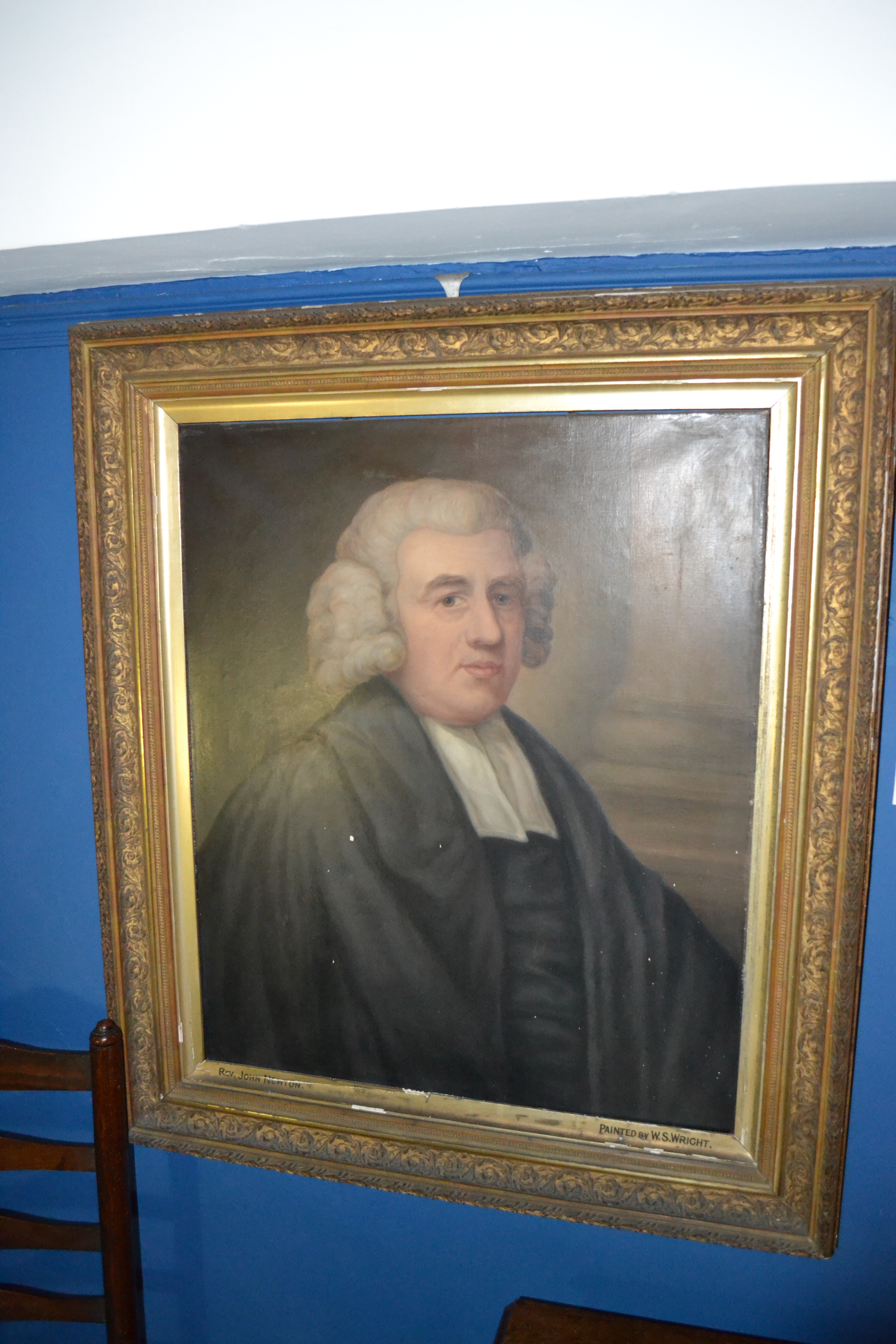
The trouble with writing a great hymn like Amazing Grace is that the poet’s other hymns are forgotten. John Newton wrote many hymns;  a number with his friend William Cowper (The Olney Hymns). However if you peruse Newton’s hymns you find many challenging and encouraging words. A good place to search for them is at Cyberhymnal.org.

The following hymn is a wonderful encouragement to hold to the promises of God when circumstances tempt us to look elsewhere.

This painting is at the Cowper and Newton Museum in Olney

Begone unbelief, my Savior is near,
And for my relief will surely appear:
By prayer let me wrestle, and He wilt perform,
With Christ in the vessel, I smile at the storm.

Though dark be my way, since He is my Guide,
’Tis mine to obey, ’tis His to provide;
Though cisterns be broken, and creatures all fail,
The Word He has spoken shall surely prevail.

His love in time past forbids me to think
He’ll leave me at last in trouble to sink;
Each sweet Ebenezer I have in review,
Confirms His good pleasure to help me quite through.

Determined to save, He watched o’er my path,
When Satan’s blind slave, I sported with death;
And can He have taught me to trust in His Name,
And thus far have brought me, to put me to shame?

Why should I complain of want or distress,
Temptation or pain? He told me no less:
The heirs of salvation, I know from His Word,
Through much tribulation must follow their Lord.

How bitter that cup, no heart can conceive,
Which He drank quite up, that sinners might live!
His way was much rougher, and darker than mine;
Did Jesus thus suffer, and shall I repine?

Since all that I meet shall work for my good,
The bitter is sweet, the medicine is food;
Though painful at present, wilt cease before long,
And then, O! how pleasant, the conqueror’s song!

Categories: christian, Christianity, Devotional, Faith, hymns, Uncategorized | Tags: , , , | Leave a comment

Who is the Prettiest One Of All?

Yesterday I wrote a poem (Mirror, Mirror) which reflected on an old theme – Narcissism. Many young (and not so young) people are hooked on acceptance via social media. It gives their lives electricity and meaning. From the first thing in the morning to the last thing at night, cell phones and computers are checked for messages – for affirmation. In fact, for many, the phones keep beeping the messages throughout the night.

Part of this process involves what I call (and excuse the crassness) – “tartification”. Girls especially, post images which portray an oversexualised image of themselves. I don’t just find the images disturbing but also the thinking that leads to the presentation of that image. Many of these images scream, “This is how I think you (in Social-media-land) want me to look. And I want you to believe that I fit that image.”

How do we counter this? Our challenge as parents, teachers and pastors is to encourage our young people to see that true beauty is what God sees – the heart with its attitudes and values. True beauty stems from loving our neighbour – not from being obsessed with ones self. Furthermore, the heart is reflected in the way we present ourselves.

Proverbs 27:19 tells us “As water reflects the face, so one’s life reflects the heart.”

We need to challenge ourselves and our young people to realise that our “online” image like the water in Proverbs 27 reflects us. So what does it reflect in each of our lives? What does our online persona say about us and therefore, about our heart?

As adults we need to be careful about putting undue emphasis on outward appearance but rather, we should be eager to praise the beautiful glimpses of the heart that young people may give us. We need to be models in our online lives, just as in our day to day lives, of what a healthy Christian life looks like.

I am always encouraged by Paul’s challenge: Finally, brothers and sisters, whatever is true, whatever is noble, whatever is right, whatever is pure, whatever is lovely, whatever is admirable—if anything is excellent or praiseworthy—think about such things. Whatever you have learned or received or heard from me, or seen in me—put it into practice. And the God of peace will be with you. Phil 4:8&9

Categories: christian, Christianity, Devotional, Reflections, Uncategorized | Tags: , , , | 3 Comments

Blog at WordPress.com.